Skip to content




Your air conditioner’s SEER rating measures how efficiently it converts electricity into cooling power over an entire cooling season. SEER stands for Seasonal Energy Efficiency Ratio, and it works like your car’s miles-per-gallon rating. The higher the number, the less energy your AC uses to keep your home comfortable, which means lower utility bills for you.
Key Takeaways
- SEER measures cooling efficiency: Higher ratings mean your AC uses less electricity to cool your home, reducing your monthly energy bills.
- SEER2 replaced SEER in 2023: The Department of Energy introduced stricter testing standards that better reflect real-world performance.
- Idaho Falls requires 13.4 SEER2 minimum: As a northern state, Idaho has specific efficiency requirements for new AC installations.
- Upgrading saves money: Replacing an AC unit that is 10 or more years old can save you 20-40% on cooling costs each year.
What Does SEER Rating Mean?
SEER is calculated by dividing the total cooling output of your air conditioner during a typical cooling season by the total electrical energy it consumes. The cooling output is measured in British Thermal Units (BTUs), and the energy input is measured in watt-hours.
Think of it this way: a 16 SEER air conditioner delivers the same cooling as a 14 SEER unit but uses about 14% less electricity to do it. Over a 15-year lifespan, that efficiency difference can add up to significant savings on your energy bills.
Where to Find Your AC’s SEER Rating
Locating your current system’s SEER rating is straightforward. Check the yellow and black EnergyGuide label on the side of your outdoor condenser unit. This sticker displays the SEER rating prominently, along with estimated annual operating costs.
If the label is missing or faded, look for a paper tag attached to your indoor air handler, typically located in your attic, basement, or utility closet. You can also find the model number on your unit and contact the manufacturer directly or search their website for the specifications.
Need this handled in Idaho Falls? See our AC installation page or call (208) 521-2041.
What Is the Difference Between SEER and SEER2?
On January 1, 2023, the Department of Energy introduced SEER2 as the new efficiency standard. This update changed how air conditioners are tested, not how they actually perform. The goal was to create ratings that better reflect how your system operates in real-world conditions.
Why the DOE Changed the Testing Standard in 2023
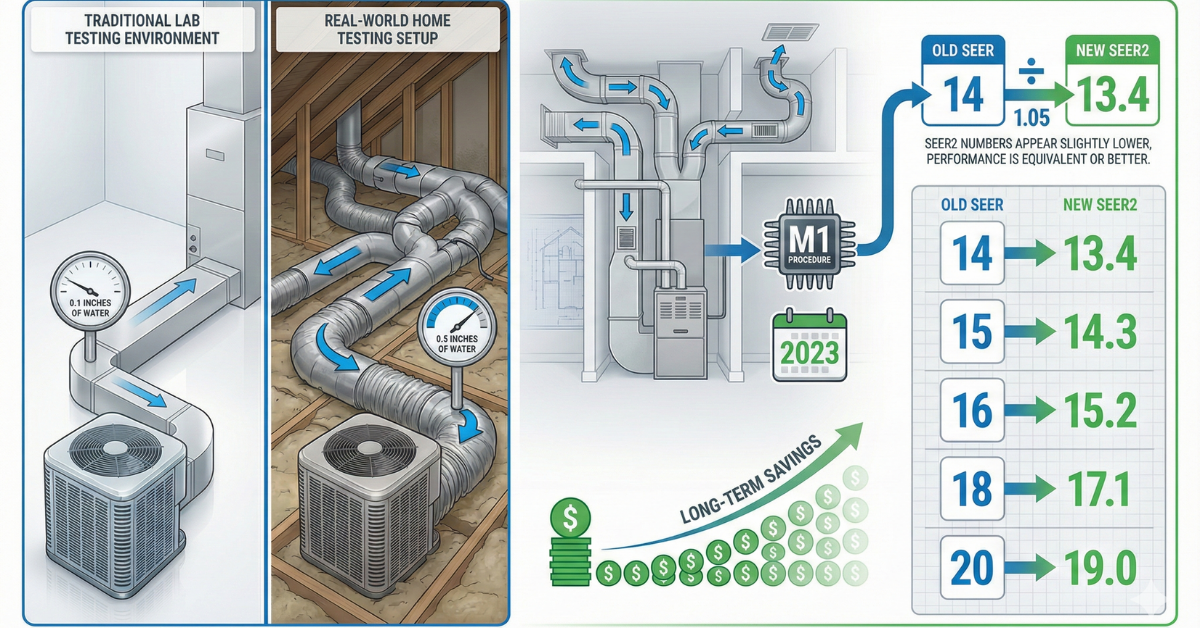
The original SEER testing measured efficiency under ideal laboratory conditions that rarely match what happens in your home. The new SEER2 testing uses the M1 procedure, which increases external static pressure from 0.1 to 0.5 inches of water. This simulates the resistance your ductwork creates in real installations.
The Department of Energy estimates these new standards will help American homeowners save between $3 billion and $12 billion on energy bills over the next 30 years.
How to Convert SEER to SEER2
Because of the stricter testing, SEER2 ratings are approximately 4.5% lower than the equivalent SEER rating. To convert your older system’s SEER rating to SEER2, divide by 1.05.
SEER to SEER2 Conversion Examples:
| Old SEER Rating | Equivalent SEER2 |
| 14 SEER | 13.4 SEER2 |
| 15 SEER | 14.3 SEER2 |
| 16 SEER | 15.2 SEER2 |
| 18 SEER | 17.1 SEER2 |
| 20 SEER | 19.0 SEER2 |
What Is a Good SEER Rating for Idaho Falls Homes?
Idaho falls within the DOE’s Northern Region, which has different minimum efficiency requirements than southern states. Understanding these regional standards helps you make an informed decision when replacing your cooling system.
Minimum Requirements for Northern States
As of 2023, all new air conditioners installed in Idaho must meet a minimum of 13.4 SEER2 (equivalent to 14 SEER under the old testing). Heat pumps must meet 14.3 SEER2 and 7.5 HSPF2 nationally.
These minimums represent the legal floor, not necessarily the best choice for your home. Idaho Falls experiences warm summers where your AC works hard during July and August, so investing in higher efficiency often makes sense.
Recommended SEER2 Ratings by Budget and Goals
Most homeowners find the best balance between upfront cost and long-term savings with units rated between 15 and 18 SEER2. Here is a general guide:
- Budget-conscious (13.4-14.3 SEER2): Meets minimum requirements with lower upfront cost, best for homes with limited AC usage.
- Balanced choice (15-17 SEER2): Offers meaningful energy savings without the premium price of top-tier models, ideal for most Idaho Falls homes.
- Maximum efficiency (18+ SEER2): Best for homeowners prioritizing lowest possible operating costs and environmental impact, often features variable-speed technology.
A 20 SEER2 unit is about 43% more efficient than a 14 SEER2 system. That efficiency comes from advanced features like two-stage or variable-speed compressors that adjust output based on your cooling needs.
How Does an Air Conditioner’s SEER Rating Affect Your Energy Bills?
The relationship between SEER ratings and your wallet is simple: higher ratings mean lower operating costs. But the actual dollar savings depend on several factors, including your electricity rates, how often you run your AC, and your home’s insulation quality.
Energy Savings Comparison by SEER Rating
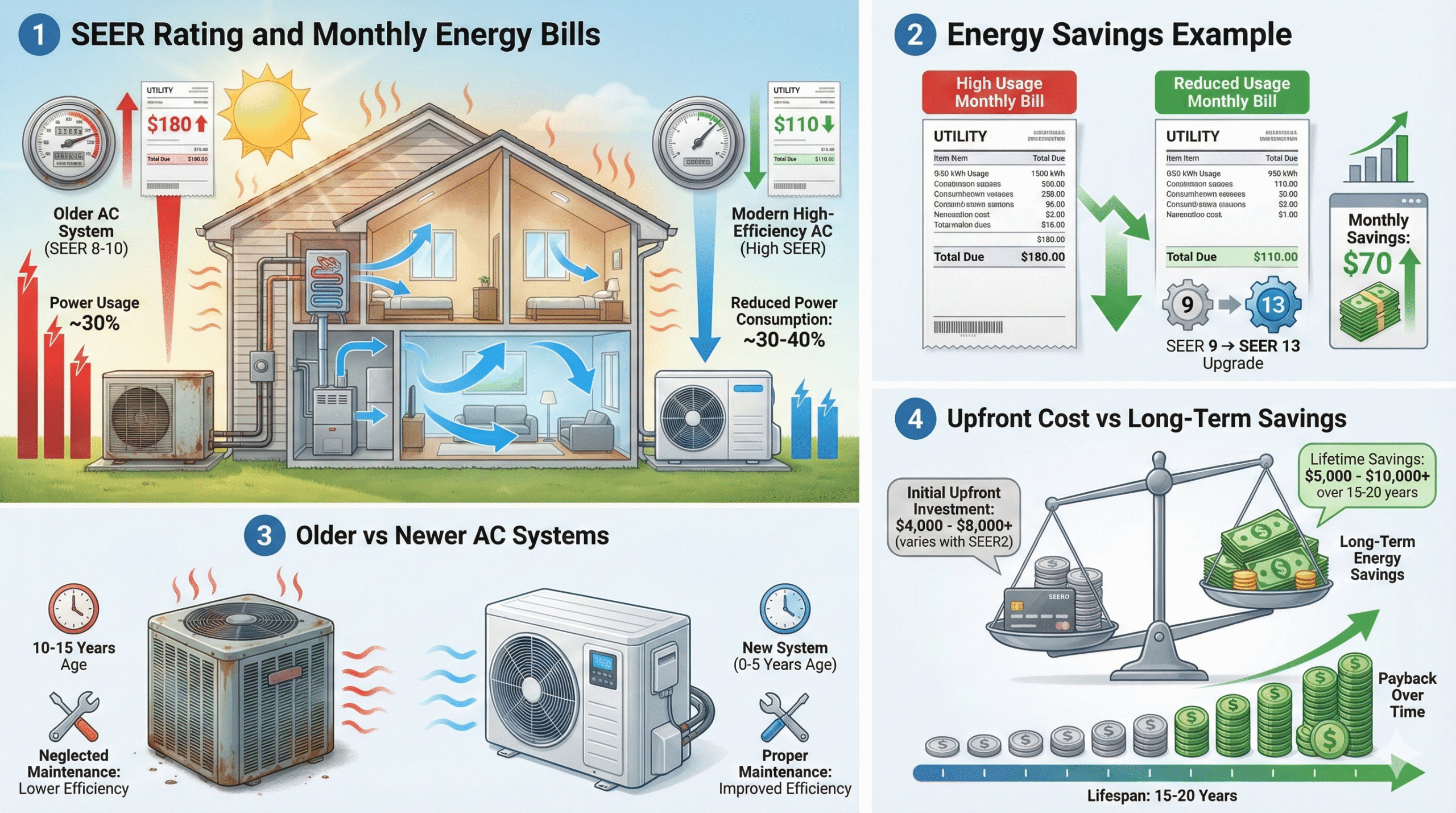
Consider this example: upgrading from SEER 9 to SEER 13 reduces power consumption by 30%. For a home with $300 monthly summer cooling costs, that translates to roughly $90 in monthly savings.
Air conditioning units built 10 to 15 years ago typically have SEER ratings between 8 and 10. If your system falls in this range, replacing it with a modern high-efficiency unit could cut your cooling costs dramatically. Proper regular HVAC maintenance also helps your system perform at its rated efficiency.
Long-Term Cost vs. Upfront Investment
Higher SEER units cost more to purchase and install. You might pay an extra $900 to $1,500 going from a 14 SEER2 system to a 16 SEER2 model. Upgrading to a 20+ SEER2 unit can add $3,000 to $5,000 to your project cost.
However, these investments often pay for themselves through energy savings over the system’s 15-20 year lifespan, especially in homes where the AC runs frequently during summer months.
Should You Upgrade to a Higher SEER Air Conditioner?
Deciding whether to upgrade involves weighing your current system’s performance against the benefits of newer technology. Several factors can help guide your decision.
Signs Your Current AC Is Costing You Money
Watch for these indicators that your system may be inefficient:
- Your AC is more than 10 years old and has a SEER rating below 13
- Energy bills have increased even though usage habits have not changed
- Your system runs constantly without adequately cooling your home
- You are experiencing common AC problems like frequent cycling or uneven temperatures
- Repair costs are mounting and approaching the cost of replacement
Tax Credits and Rebates for High-Efficiency Systems
The federal government offers significant incentives for energy-efficient HVAC upgrades. As of 2025, split system air conditioners with SEER2 of 17 or higher qualify for tax credits up to $1,200 through the Energy Efficient Home Improvement Credit.
The overall annual limit for efficiency tax credits is $3,200, which can include combinations of HVAC equipment and home envelope improvements. Learn more about available tax incentives for new HVAC systems to maximize your savings.
For Idaho Falls homeowners planning a new AC installation, combining federal tax credits with utility rebates and energy savings makes upgrading to a high-efficiency system more affordable than ever.
Get Expert Advice on AC Efficiency in Idaho Falls
Understanding SEER ratings is the first step toward making a smart decision about your home’s cooling system. The right choice depends on your budget, how much you use your AC, and your long-term goals for energy savings and comfort.
At Ridgeline Heating and Cooling, we help Idaho Falls homeowners navigate these decisions every day. Our licensed technicians can evaluate your current system’s efficiency, calculate potential savings from upgrading, and recommend the best SEER2 rating for your specific situation.
Ready to find out if a higher-efficiency AC makes sense for your home? Contact Ridgeline Heating and Cooling to schedule a professional efficiency evaluation or request a quote for high-efficiency AC installation. Our team is here to answer your questions and help you make a confident, informed decision.
Choosing a SEER2 rating for Idaho Falls?
Our summers are short but hot, so the payback math is different here than in Phoenix. We will show you the numbers for your home as part of every AC installation quote.
Call (208) 521-2041 or request service online. Ridgeline Heating and Cooling, 370 College St, Idaho Falls, ID 83401.