Skip to content



The most common water heater repair issues in Idaho Falls include sediment buildup from hard water, pilot light failure, faulty heating elements, thermostat problems, and tank leaks. Idaho’s moderately hard to hard water supply accelerates these problems faster than in most U.S. regions.
Catching the early warning signs can save you hundreds of dollars in emergency repair costs and add years to your system’s life.
Key Takeaways
- Idaho Falls water averages around 128 mg/L of hardness, classified as “hard” by the U.S. Geological Survey, which speeds up sediment buildup in water heater tanks faster than in softer-water regions
- Most common issues, including thermostat failure, pilot light problems, and minor leaks, can be repaired without replacing the full unit
- The national average water heater repair cost in 2025 is approximately $506, though simple fixes like thermostat replacement run $150-$200
- Annual tank flushing is the single most effective preventative step for Idaho Falls homeowners
- If your unit is 10 or more years old and repairs are becoming frequent, replacement is usually more cost-effective than continued repairs
- The temperature and pressure (T&P) relief valve is your water heater’s most critical safety component and should be tested every 6 to 12 months
Why Idaho Falls Homes Are Especially Prone to Water Heater Problems
Water heater issues occur in homes across the country, but Idaho Falls homeowners face a specific combination of local conditions that stress water heater systems faster than the national average. Understanding what those conditions are is the first step toward protecting your home comfort and your budget.
The Hard Water Factor in Southeast Idaho
Idaho draws roughly 95% of its municipal water supply from underground aquifers. That groundwater picks up dissolved calcium and magnesium as it filters through rock and soil, resulting in water that is moderately hard to hard across most of the state.
According to data from the U.S. Geological Survey,hard water is defined as water containing between 121 and 180 mg/L of dissolved calcium carbonate. Idaho’s statewide average sits at approximately 128 mg/L, putting most Southeast Idaho households squarely in that hard water range. When hard water is heated inside your tank, the dissolved minerals separate and settle to the bottom, forming a layer of sediment that insulates the water from the burner and forces your system to work harder.
“Hard water is especially bad for water heaters. When water is heated, it allows far more of the dissolved minerals to separate. These minerals collect and harden to form a thick sediment on the bottom of the tank. Sediment is the main reason traditional water heaters fail.” Express Plumbing Heating & Air, Licensed Plumbing Specialists serving Idaho since 2006
In practical terms, that means Idaho Falls water heaters accumulate sediment faster, run less efficiently, make more noise, and fail earlier than units in softer-water regions of the country.
How Idaho’s Cold Winters Add Stress to Your System
Idaho Falls winters are long and cold, with temperatures regularly dropping well below freezing from November through March. That cold weather creates two additional pressures on your water heater. First, the incoming cold water supply enters your tank at a much lower temperature, forcing the heating element or burner to work harder just to reach the same output. Second, Idaho’s freeze-thaw cycle puts extra pressure on plumbing joints and fittings near the unit, which can cause leaks to develop or worsen in spring. Both factors combine to put extra strain on a system that the region’s hard water is already stressing year-round.
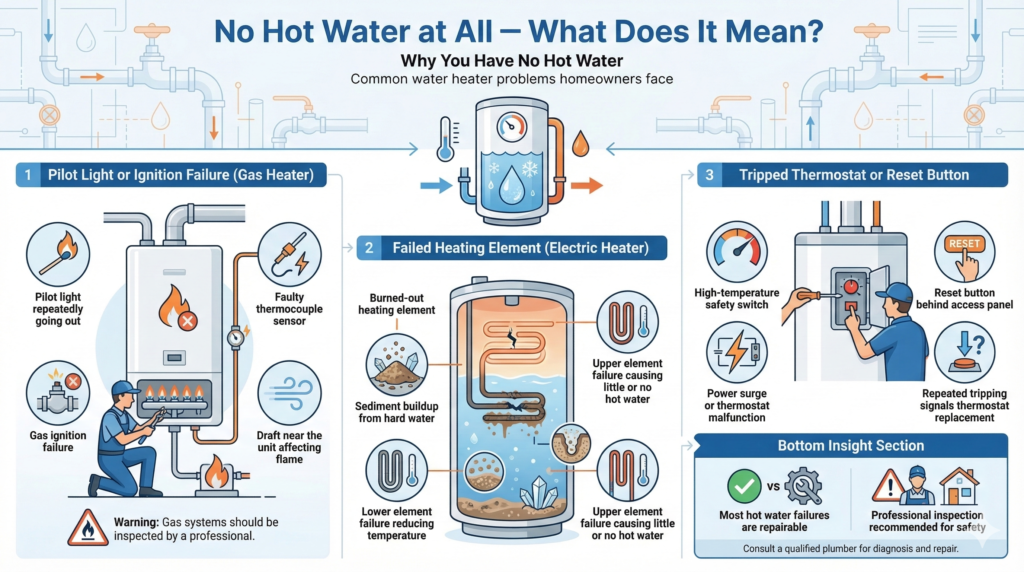
No Hot Water at All – What Does It Mean?
Waking up to zero hot water is one of the most disruptive water heater failures an Idaho Falls homeowner can face. The good news is that a complete loss of hot water does not always mean your unit needs to be replaced. Several repairable components can cause this issue, and most are affordable to fix.
Pilot Light or Ignition Failure (Gas Units)
Gas water heaters rely on a pilot light or electronic ignition to ignite the burner. If the pilot light keeps going out, a draft near the unit may be the cause. However, a repeatedly extinguishing pilot light can also signal a problem with the thermocouple, which is the small metal heat-sensing probe inside the pilot assembly responsible for detecting whether the flame is lit and keeping the gas valve open.
“If the pilot light keeps going out, it could be an indication of a bigger problem with the gas line leading to the appliance. Either way, you should have a professional take a look as soon as possible.” Criterion Plumbers, Idaho Falls Water Heater Repair Specialists, (208) 225-5588
A faulty thermocouple is a common and affordable repair, typically costing between $150 and $250 including parts and labor. Attempting to diagnose or replace gas components without proper training is not recommended, as incorrect repairs can create a carbon monoxide hazard inside your home.
Failed Heating Element (Electric Units)
Electric water heaters use one or two metal heating elements submerged inside the tank. In Idaho Falls homes with hard water, sediment buildup covers these elements over time, causing them to overheat and eventually burn out. When the lower element fails, the unit can no longer maintain water temperature. When the upper element fails, you may have very little hot water at all.
“In electric water heaters, sediment can cover heating elements, causing them to overheat and fail. This inefficiency can lead to increased energy costs, as the system has to work harder to heat water, and can also shorten the lifespan of the water heater.” Donmar Heating, Cooling & Plumbing, Certified HVAC and Plumbing Professionals
Replacing a heating element typically costs between $200 and $300 in 2025, including parts and labor from a certified technician.
Tripped Thermostat or Reset Button
Electric water heaters have a high-temperature safety switch that cuts power to the heating elements if the water reaches a dangerous temperature. This reset button, usually located behind a small access panel on the unit, can trip after a power surge or thermostat malfunction. Pressing the reset button restores power. If the button trips repeatedly, the thermostat likely needs replacement, which runs $150 to $200 including labor.
Not Enough Hot Water – What’s Going On?
Running out of hot water faster than you used to is one of the earliest signs that something is wrong with your water heater. Two causes are especially common in Idaho Falls homes and each has a distinct solution.
Sediment Buildup at the Bottom of the Tank
Hard water mineral deposits accumulate at the bottom of a storage water heater tank over time. That sediment layer acts like insulation between the burner and the water, reducing the amount of heat that actually reaches your hot water supply. The result is a tank that still heats, but cannot produce enough hot water fast enough to meet your household’s needs.
“As sediment collects, your heater needs more energy to warm the water. That means higher utility bills and slower recovery times. This can be especially frustrating when multiple showers or appliances are in use.” Just Water Heaters Idaho, Local Idaho Water Heater Specialists
In Idaho Falls, flushing your water heater annually is strongly recommended. In harder-water areas of Southeast Idaho, twice-yearly flushing may be necessary to keep performance where it should be. A certified technician from Ridgeline can assess your tank’s condition and recommend the right maintenance schedule for your home.
Undersized Unit or High Demand
If your household has grown since your current water heater was installed, your unit may simply not have enough capacity for your needs. A standard 40-gallon tank serves two to three people reasonably well. Four or more people typically require a 50-gallon unit or a tankless system. An undersized tank is not a repair issue, but it is important to identify because flushing and maintenance alone will not solve a capacity problem.
Strange Noises Coming from Your Water Heater
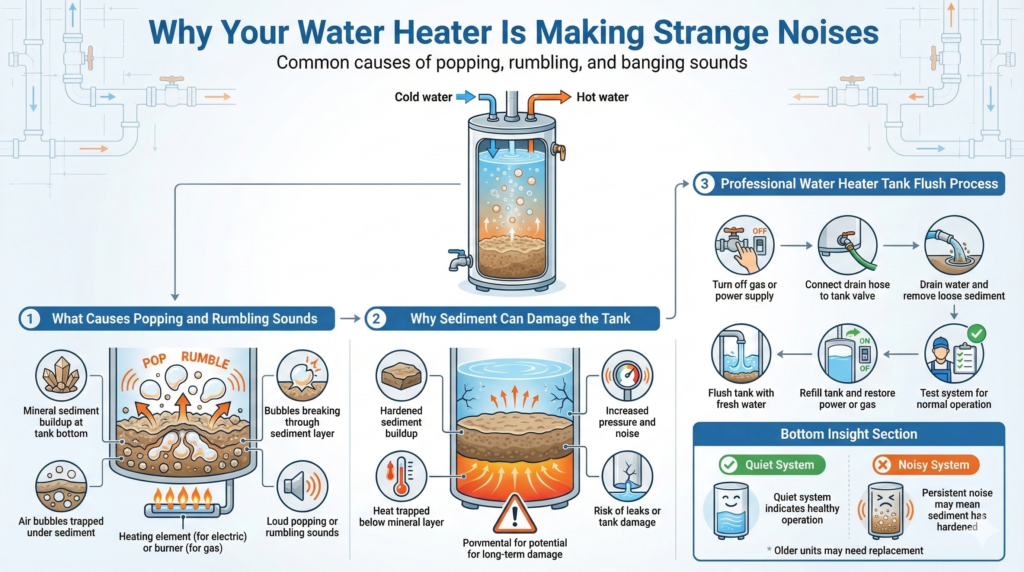
A quiet water heater is a healthy one. Popping, rumbling, or banging sounds coming from your utility room are your system’s way of signaling a problem worth addressing promptly.
Popping and Rumbling Sounds
Popping and rumbling are the most common water heater noises reported by Idaho Falls homeowners, and sediment is almost always the cause. As the burner heats the water beneath a hardened sediment layer, trapped air bubbles force their way upward and disturb the sediment, creating those distinctive sounds.
“Hardened sediment can damage the water heater. The tipoff for property owners is when hardened sediment builds up and starts banging around the water heater. If this issue isn’t resolved, it can eventually lead to leaks.” Criterion Plumbers, Water Heater Repair in Bonneville County, Idaho
According to local plumbing data for Idaho, water heater noise from sediment accumulation is among the most frequently reported home maintenance issues statewide, directly tied to the region’s high mineral content in groundwater.
When Flushing the Tank Solves the Problem
If the noise is caught early and the sediment has not yet fully hardened, flushing the tank can often resolve the problem completely. A professional flush involves the following steps:
- Shut off the gas or power supply to the unit
- Connect a drain hose to the tank’s drain valve
- Drain the full tank to remove loose sediment
- Flush with fresh cold water until the discharge runs clear
- Close the drain valve and refill the tank
- Restore power or gas and test the unit for normal operation
If persistent noise continues after a professional flush, the sediment has likely hardened beyond what flushing can correct, and the unit may be approaching the end of its serviceable life.
Leaks, Rusty Water, and Discoloration
Leaks and discolored hot water are among the most urgent signs that your water heater needs immediate attention. The location of the leak and the source of the discoloration both determine whether a repair or a full replacement is the right call.
Where the Leak Is Coming From Matters
Not every visible leak near a water heater is a tank problem. Many Idaho Falls homeowners mistake a leaking pipe fitting, pressure relief valve, or connection point for a tank failure. If the leak originates from a fitting, valve, or joint, it can almost always be repaired affordably. If the leak is coming from the tank seam or the interior tank wall, that is a more serious situation.
“If your water heater tank is leaking at the seam or from the interior tank, the leak cannot be repaired. Corrosion has caused the tank to deteriorate and weaken such that it develops a leak. This is particularly common for water heaters 7 or more years old that have not been maintained.” USW Pro, Certified Water Heater Service Professionals
The T&P Relief Valve – A Critical Safety Component
The temperature and pressure (T&P) relief valve is mounted on the top or side of your water heater tank. Its job is to automatically release pressure if the tank temperature exceeds 210°F or internal pressure exceeds 150 PSI, preventing a dangerous tank rupture.
“The T&P valve is your water heater’s most important safety feature. If your T&P valve hasn’t been tested or replaced in five years, experts agree it’s best to replace the valve. A stuck valve can prevent pressure relief, potentially leading to dangerous pressure buildup.” This Old House, Trusted Home Improvement Authority, citing licensed plumbing expert Richard Trethewey
Experts recommend testing the T&P valve every 6 to 12 months by carefully lifting the release lever and confirming water flows through the discharge pipe. If the valve does not release water when tested, or if it leaks constantly during normal operation, it needs immediate professional attention. Replacement typically costs $200 to $300 including parts, labor, and a safety inspection.
What Rust-Colored Hot Water Tells You
If your hot water comes out with a rust or reddish-brown tint while the cold water runs clear, the issue is inside your water heater tank. The most likely cause is a depleted anode rod or active internal corrosion. The anode rod is a sacrificial metal rod, typically made of magnesium or aluminum, that is designed to corrode in place of the steel tank walls. When the anode rod is fully depleted, the tank interior is left unprotected and rust begins to form.
“Anode rods do not last forever. Their lifespan can range from three to five years, depending on water quality and the type of rod used. In hard water areas, magnesium anode rods may degrade more quickly, and aluminum rods are often better suited to those conditions.” Adaven Plumbing Inc., Licensed Plumbing Professionals
For more on rust in your hot water supply, Ridgeline has published a detailed guide covering the causes and solutions. Replacing an anode rod costs approximately $250 to $300 and should be done every three to five years as a preventative measure. If rust-colored water persists after anode rod replacement, the tank interior may already be compromised and a full replacement should be evaluated.
Rising Energy Bills Without Explanation
If your monthly utility bills have increased without a clear reason, your water heater may be drawing more energy than it should. A unit working harder to compensate for sediment buildup, a failing heating element, or a worn thermostat will consume more energy for the same hot water output.
According to the U.S. Department of Energy, water heating accounts for approximately 18% of a typical home’s total energy use, making it the second largest energy expense after space heating and cooling. Even a modest efficiency drop caused by sediment or a failing component can add meaningfully to your monthly bill over time.
“Sediment buildup can mean the water flow isn’t efficient, and when a system has to work harder, it costs more to maintain. If you can’t explain higher bills through a significant change in lifestyle, call a water heater repair technician.” Criterion Plumbers, Idaho Falls and Bonneville County, Idaho
Setting your water heater thermostat to 120°F, as recommended by the U.S. Department of Energy, strikes the right balance between comfortable output and efficient operation. If your bills are rising and your unit is over eight years old, a professional inspection is the most cost-effective first step before committing to a full replacement.
5 Checks to Run Before You Call a Technician
Before scheduling a service visit, run through this quick checklist. Some issues have simple fixes that do not require a professional call, while others confirm you need an expert right away.
- Check the circuit breaker or gas supply – A tripped breaker or closed gas valve will cut your hot water entirely. Reset the breaker or confirm the gas supply valve is fully open before assuming a component failure.
- Press the reset button on electric units – Locate the small red reset button on the upper thermostat access panel. If it trips again within hours, a thermostat or element replacement is needed.
- Try relighting the pilot light – Gas units with a pilot that has simply gone out can often be relit by following the instructions on the label near the burner. If the pilot will not stay lit after relighting, a thermocouple replacement is likely needed.
- Check the T&P relief valve discharge pipe – If the pipe is consistently warm or dripping, the valve may be releasing pressure due to overheating. This warrants a professional inspection promptly.
- Listen for noise while the unit heats – Mild hissing is normal. Loud popping, banging, or rumbling while the burner is active signals significant sediment buildup requiring a professional flush or system assessment.
When Should You Repair vs. Replace Your Water Heater in Idaho Falls?
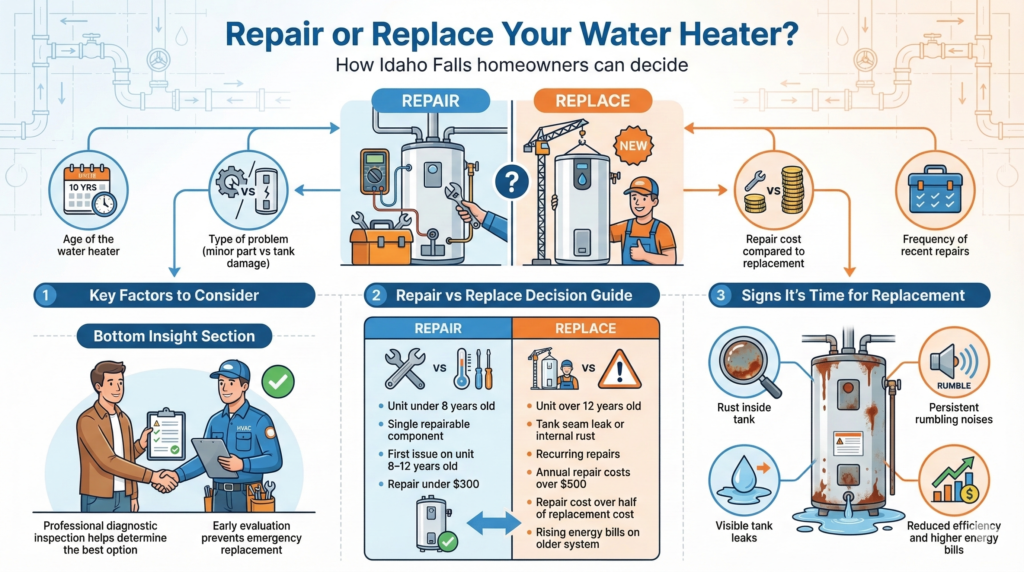
Deciding between repair and replacement depends on four factors: the age of the unit, the nature of the problem, the cost of the repair, and your unit’s recent repair history.
| Situation | Recommended Action |
| Unit under 8 years old, single repairable component | Repair |
| Unit 8-12 years old, first issue | Repair with professional inspection |
| Unit over 12 years old, recurring repairs | Replace |
| Tank seam leaking or internal rust confirmed | Replace |
| Annual repair costs exceed $500 | Replace |
| Repair cost exceeds 50% of replacement cost | Replace |
| Rising energy bills combined with age over 10 years | Consider replacing |
As a general rule from industry repair cost data for 2025, repairs under $300 on a unit less than 10 years old typically make solid financial sense. When a unit is over 10 years old and repair costs exceed $500 annually, the long-term energy savings and reliability of a new system usually outweigh continued repair expenses.
Nicholas McIntier, owner and licensed HVAC contractor at Ridgeline Heating and Cooling, puts it plainly:
“Not every issue means you immediately need a new water heater. Thermostat problems can be fixed by adjusting or replacing the part. But if you’re seeing rust, hearing persistent noise, or experiencing leaks from the tank itself, it’s usually time for a replacement. The signs it’s time to replace your water heater are usually pretty clear once you know what to look for.” Nicholas McIntier, Owner & Licensed HVAC Contractor, Ridgeline Heating and Cooling (licensed 2021, serving Idaho Falls since 2017)
For homeowners who are unsure, a professional diagnostic visit is the fastest way to get an honest, unbiased assessment and a clear repair-versus-replace recommendation.
What Idaho Falls Homeowners Say About Ridgeline
“We had no hot water on a Friday morning in January. Ridgeline came out the same day, diagnosed a failed heating element, and had it fixed before dinner. Straightforward pricing, no pressure. We’ve used them for our furnace too and couldn’t be happier.” Sarah M., Verified Ridgeline Customer, Idaho Falls, ID
Ridgeline maintains a 100% satisfaction guarantee and same-day scheduling for water heater emergencies across Southeast Idaho.
How Ridgeline Heating and Cooling Can Help
Ridgeline Heating and Cooling is a family-owned HVAC and home services company serving Idaho Falls and the surrounding communities of Southeast Idaho. When your water heater is acting up, you deserve a clear answer and reliable service, not a guessing game.
Our certified technicians provide:
- Same-day water heater repair in Idaho Falls for most common issues
- Honest diagnostic assessments with clear repair-versus-replace recommendations
- A 1-year warranty on all water heater repairs
- Professional installation of new tank and tankless water heater systems
- Preventative HVAC and water heater maintenance plans that keep your system running efficiently year-round
Idaho Falls winters are not the time to discover your water heater has been quietly struggling. If you are hearing unusual noises, noticing rusty water, running out of hot water faster than before, or simply want a professional inspection before a problem develops, contact Ridgeline today. You will get an honest assessment, upfront pricing, and reliable service from a local team that knows Southeast Idaho homes.
Call Ridgeline Heating and Cooling or book online at idahofallsheatingandcooling.com to schedule your water heater inspection or repair.