Skip to content




A mini split system is a ductless heating and cooling unit made up of one outdoor compressor and one or more indoor air handlers connected by refrigerant lines. Rather than burning fuel to generate warmth, it transfers heat between indoors and outdoors, making it 30 to 40% more energy-efficient than traditional heating systems. One installation handles both summer cooling and winter heating.
Key Takeaways
- Heat transfer, not combustion: Mini splits move heat rather than create it, which is the basis for their efficiency advantage over furnaces and baseboard heaters.
- Up to 60% energy savings: ENERGY STAR certified mini splits use up to 60% less energy than standard electric resistance heaters, according to the U.S. EPA.
- Room-by-room zone control: A single outdoor unit can power up to 4 to 6 independent indoor air handlers, each with its own temperature setting.
- Built for cold climates: Modern hyper-heat models operate efficiently down to −13°F, making them a practical choice for Idaho Falls winters.
- No duct losses: The U.S. Department of Energy reports that central forced-air duct systems lose more than 30% of their energy in transit. Mini splits bypass this entirely.
What Is a Mini Split System and How Mini Split Systems Work?
A mini split system is a ductless, all-in-one heat pump that heats and cools a home without relying on a network of air ducts. It delivers precise, room-by-room climate control throughout every season. Whether the goal is cooling a home addition in July or warming a finished basement through an Idaho Falls winter, a single mini split installation handles both jobs.
The Two Core Components
Outdoor unit: Houses the compressor and condenser coil, the mechanical core of the system. It absorbs or releases heat depending on the season and mounts on a concrete pad or exterior wall bracket outside the home.
Indoor air handler: Mounts on an interior wall or ceiling and delivers conditioned air directly into the room. The two units connect through a small conduit typically a 3-inch hole through the wall carrying refrigerant lines, a power cable, and a condensate drain. The outdoor unit can sit up to 50 feet from the indoor handler, giving installers considerable placement flexibility.
How a Mini Split Differs From a Central Air System
A central air system uses one large air handler to push conditioned air through a duct network that reaches every room simultaneously. Air temperature and quality can degrade as it travels through those ducts, especially in homes where ducts are poorly sealed or insulated. A mini split removes the duct network entirely. Each indoor unit treats the air right in the room where it sits, delivering more consistent temperatures and eliminating duct-related energy losses.
For a side-by-side look at ducted and ductless air systems, see our guide on forced air vs. central air.
| “Ductless mini-splits have no ducts, avoiding the energy losses associated with the ductwork of central forced-air systems, which can account for more than 30% of energy consumption for space conditioning.” U.S. Department of Energy, Office of Energy Efficiency and Renewable Energy, energy.gov |
How Do Mini Splits Cool Your Home?
In cooling mode, a mini split removes heat from inside the home and releases it outdoors. The process relies on the vapor-compression refrigeration cycle, the same physics that powers a standard air conditioner, applied without ductwork and with greater efficiency thanks to inverter-driven compressors.
The Cooling Cycle: Step by Step
Here is exactly how a mini split removes heat from a room:
- Warm room air enters the indoor unit. The air handler draws room air through a filter and across a cold evaporator coil filled with refrigerant.
- Refrigerant absorbs the heat. The liquid refrigerant absorbs heat energy from the room air and converts into a gas, cooling the air in the process.
- Cooled air returns to the room. The now-cooled air is blown back into the living space, lowering the room temperature.
- Hot refrigerant gas travels to the outdoor unit. The warm refrigerant gas flows through insulated lines to the outdoor condenser.
- Heat is expelled outdoors. The outdoor compressor pressurizes the gas, causing it to release its heat into the outside air.
- Refrigerant resets and the cycle repeats. The refrigerant cools back into a liquid and the process starts again continuously.
For a deeper look at how the heat exchange coils function within this cycle, our article on heat exchangers and how they work explains the mechanics in plain terms.
How Inverter Technology Improves Efficiency
Most mini splits use inverter-driven variable-speed compressors rather than the simple on/off compressors found in older systems. A conventional compressor runs at full power until the room reaches the set temperature, then shuts off completely, cycling on again a few minutes later. This stop-start pattern wastes energy and creates temperature swings.
An inverter compressor modulates its speed continuously, running faster when rapid cooling is needed and dropping to near-idle once the room stabilizes. The result is steadier temperatures, quieter operation, and lower electricity costs. A 9,000 BTU mini split rated at 28 SEER2 can cost as little as $110 per year to run in a mixed climate, compared to $170 or more for a lower-efficiency model logging the same hours.
| “Inverter technology eliminates the energy-intensive on-and-off cycling of traditional compressors, resulting in smoother operation and significantly reduced energy consumption over a full cooling season.”GREE Comfort Engineering Team, HVAC Systems Design, greecomfort.com |
How Do Mini Splits Heat Your Home?
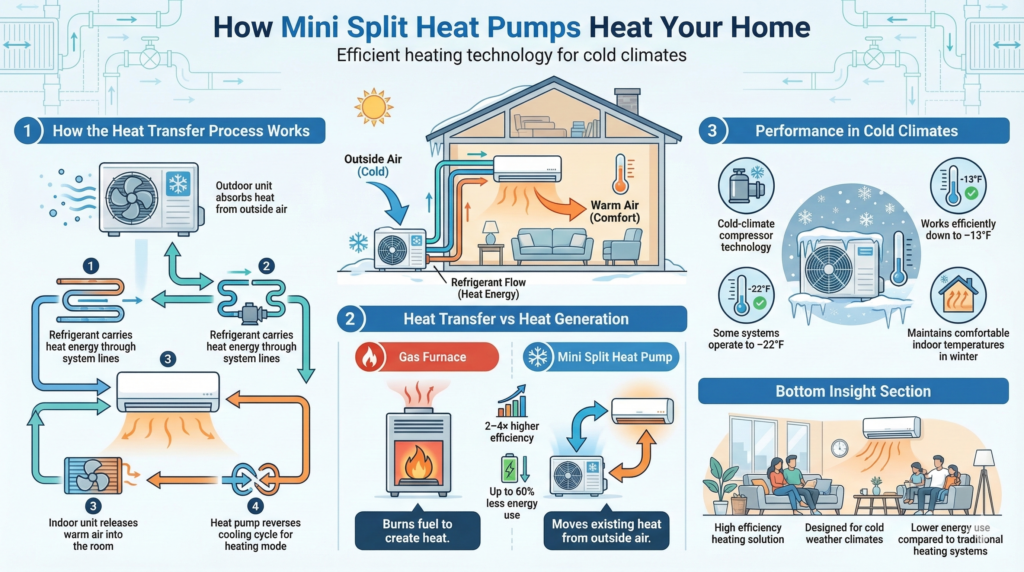
A mini split heat pump heats a home by reversing the refrigerant cycle. Instead of pulling heat from indoor air and sending it outside, the system extracts heat energy from the outdoor air and transfers it indoors. This works even in cold weather because outdoor air always contains some heat energy the refrigerant is engineered to absorb it at very low temperatures.
Why Heat Transfer Beats Heat Generation
A gas furnace burns fuel to create heat. A mini split heat pump moves existing heat from one location to another. Moving something requires far less energy than manufacturing it from scratch. According to Rewiring America, a mini split in heating mode is 2 to 4 times more efficient than a gas furnace, baseboard heater, or boiler. ENERGY STAR certified mini splits carry this further, using up to 60% less energy than standard electric resistance heaters, according to the U.S. EPA.
Can a Mini Split Handle Idaho Falls Winters?
This is the question Idaho Falls homeowners ask most before committing to a mini split, and the answer is yes with the right equipment. Cold-climate and hyper-heat mini split models use advanced compressor technology to extract usable heat from outdoor air down to −13°F, with some units continuing to operate at reduced output as low as −22°F.
Idaho Falls records average January lows of around 15°F, well within the efficient operating range of a properly specified cold-climate unit. Ridgeline technicians have installed these systems throughout Idaho Falls, Ammon, Rexburg, and Pocatello and homeowners consistently report maintaining comfortable indoor temperatures through Idaho’s coldest stretches without supplemental heat.
Considering a mini split as your primary heating source? Our guide on whether you can use mini splits as your only heating source walks through the full decision for Idaho’s climate.
| “Many new ENERGY STAR certified mini split models excel at providing space heating even in the coldest climates, as they use advanced compressors and refrigerants that allow for improved low-temperature performance.”U.S. Environmental Protection Agency, ENERGY STAR Program, energystar.gov |
What Is Zone Control and Why Does It Matter?
Zone control allows a mini split system to condition individual rooms independently rather than treating the entire home as a single temperature zone. Each indoor air handler has its own thermostat, schedule, and settings, so different rooms can be kept at different temperatures at the same time.
Single-Zone vs. Multi-Zone Systems
Single-zone systems pair one outdoor unit with one indoor air handler. They are ideal for a specific room that needs dedicated support a sunroom, finished basement, home addition, or any space that the central system struggles to reach.
Multi-zone systems connect one outdoor unit to up to 4 to 6 indoor air handlers, each serving a separate room or area. Every zone operates independently. You can heat the master bedroom while cooling the home office, or shut off zones in unused rooms entirely. According to Rewiring America, homes with central ducted systems lose 20 to 30% of conditioned air through the duct network itself. Multi-zone mini splits eliminate that loss entirely.
How Each Zone Is Controlled
Every indoor unit comes with a handheld remote for direct room control. Most modern mini splits also connect to Wi-Fi-enabled smart thermostats and mobile apps, giving homeowners zone-by-zone management from their phone. Advanced models include occupancy sensors that automatically scale back output in empty rooms and restore comfort settings when someone enters, cutting energy use further without any manual adjustment.
Understanding Mini Split Efficiency Ratings
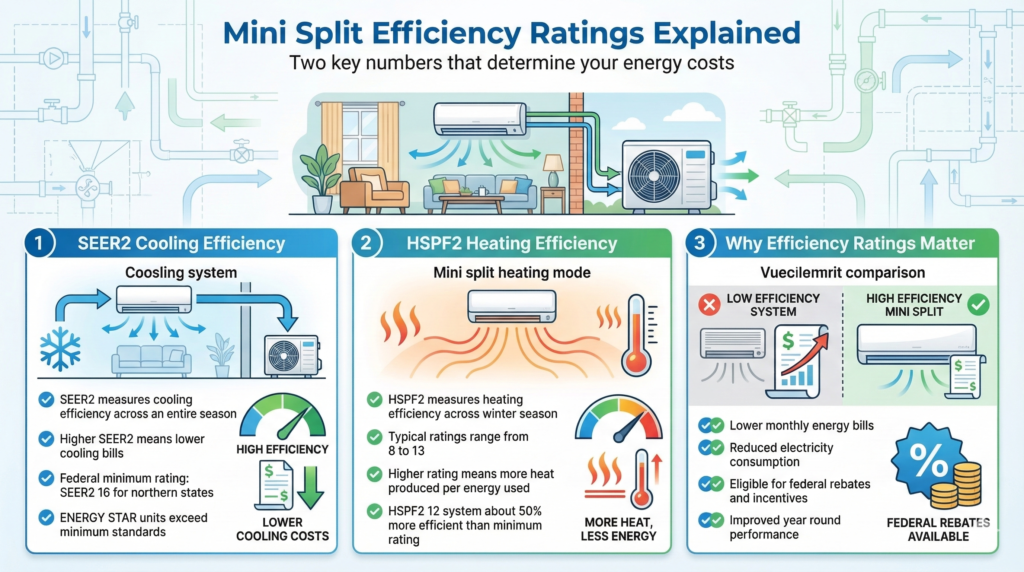
Two efficiency ratings determine a mini split’s operating costs one for each season. Both are measured under updated federal standards that took effect in 2023. Checking both numbers before purchasing ensures the system qualifies for available rebates and delivers real savings year-round.
SEER2: Cooling Efficiency
SEER2 (Seasonal Energy Efficiency Ratio 2) measures how efficiently a system cools your home across an entire season. A higher SEER2 rating means lower cooling bills. As of January 2025, federal law sets SEER2 16 as the minimum for new ductless mini split installations in northern states. ENERGY STAR certified systems exceed this threshold and may qualify for federal rebates covering up to 30% of the installed project cost.
HSPF2: Heating Efficiency
HSPF2 (Heating Seasonal Performance Factor 2) measures heating efficiency across a full heating season. Most modern mini splits carry HSPF2 ratings between 8 and 13. A system rated HSPF2 12 is approximately 50% more efficient than a unit at the federal minimum of 8.2. For Idaho Falls homeowners running the system through a long heating season, a higher HSPF2 rating translates directly into lower monthly bills.
Before purchasing, review the tax incentives available for new HVAC in 2026 to see which systems qualify for rebates in Idaho.
Mini Split Efficiency vs. Common Alternatives (2025 Federal Standards)
| System | Heating | Cooling | Ducts? |
| Mini Split (heat pump) | HSPF2: 8–13 | SEER2: 16+ min | No |
| Gas Furnace | AFUE: 80–98% | N/A (separate AC) | Yes |
| Electric Baseboard | 100% resistance | N/A | No |
| Central AC + Furnace | AFUE: 80–98% | SEER2: ~14.3 | Yes |
Sources: U.S. Department of Energy; ENERGY STAR; federal SEER2 and HSPF2 minimum standards, effective January 2025.
Is a Mini Split Right for Your Idaho Falls Home?
Mini splits perform well across a wide range of homes in the Idaho Falls area, particularly in situations where ductwork is impractical, absent, or in need of replacement. Here are the use cases where a mini split consistently delivers the clearest value:
- Older homes without ductwork: Retrofitting central air requires duct installation throughout the structure, which can add thousands to the project cost. A mini split eliminates that requirement entirely.
- Home additions and converted spaces: New rooms, finished basements, and converted garages typically sit beyond the reach of an existing central system.
- Rooms with persistent comfort problems: Upstairs bedrooms that overheat in summer or home offices that stay cold in winter are classic candidates.
- Supplemental heating alongside a furnace: A mini split can handle the majority of the heating load at high efficiency, with the gas furnace covering only the coldest hours.
- Energy-conscious homeowners: If long-term cost reduction is a priority, a properly sized mini split is one of the most effective HVAC upgrades available.
For a structured walkthrough of whether a mini split fits your specific home, see our guide on whether mini split systems are right for your home.
Frequently Asked Questions
How long does a mini split system last?
How much does mini split installation cost in Idaho Falls?
Can a mini split heat an entire house?
Do mini splits work during power outages?
Ready to Talk to a Local Mini Split Expert?
Our licensed technicians serve Idaho Falls, Ammon, Rexburg, Pocatello, and the surrounding Eastern Idaho communities. We assess your home, recommend the correct system size, and walk you through every rebate and incentive available in 2026.
Contact Ridgeline Heating and Cooling today to schedule your consultation.