 Skip to content



A complete seasonal heating maintenance checklist for Idaho Falls homeowners includes replacing air filters, testing thermostat accuracy, clearing vents, inspecting visible ductwork, and scheduling a professional furnace tune-up every fall. With Idaho Falls winters regularly dipping to lows around 14°F, catching small problems before the first cold snap protects your home and avoids emergency repair costs.
Key Takeaways
- Idaho Falls winters drop to approximately 14°F, placing significant seasonal demand on home heating systems
- Fall is the best time to schedule furnace maintenance before HVAC technicians are fully booked for winter calls
- Homeowners can handle filter changes, thermostat checks, and vent clearing without professional help
- A licensed technician must inspect the heat exchanger, gas pressure, burner condition, and electrical connections
- According to Idaho Power, turning your thermostat down 1 degree in winter saves approximately 3 to 5% on heating costs
- Many furnace manufacturers require documented annual professional maintenance to keep warranties valid
Why Seasonal Heating Maintenance Matters in Idaho Falls
Heating maintenance is one of the highest-return investments a homeowner in Idaho Falls can make. The average Idaho Falls resident pays around $150 per month in heating costs during winter and over 55% of total home energy bills typically go toward heating and cooling combined, according to the U.S. Department of Energy. Keeping your system properly maintained directly reduces that number.
Beyond cost savings, HVAC maintenance is a safety issue. Gas furnaces require annual professional inspection to confirm that heat exchangers are intact, carbon monoxide is not leaking into living spaces, and gas lines are sealed correctly. These are not DIY checks.
“Most heating system failures we see in winter were completely preventable. The warning signs were there months earlier a slightly longer run time, a small rise in the energy bill, a faint smell. Regular fall maintenance catches those signals before they turn into a breakdown at midnight in January.”
Kyle Harrington, NATE-Certified HVAC Technician with 14 years of residential service experience in Southeast Idaho
How Idaho Falls Climate Affects Your Heating System
Idaho Falls sits at roughly 4,700 feet elevation in the high desert of eastern Idaho. Summers average highs of 86°F while winters push lows down to around 14°F, according to local HVAC service data. That 70-plus degree seasonal temperature swing is unusually wide and places exceptional mechanical stress on home heating and cooling equipment throughout the year.
Systems that are not properly maintained heading into winter are asked to work harder during those first prolonged cold stretches. Components that are borderline a slightly dirty burner, a filter that is three months overdue, a thermostat reading 2 degrees off become genuine failure points when temperatures stay below freezing for days at a time.
What Happens When You Skip Annual Furnace Maintenance
Skipping seasonal maintenance does not save money. It delays costs and makes them larger. A clogged air filter forces the blower motor to work harder, shortening its lifespan. A dirty burner reduces combustion efficiency, meaning you burn more fuel for less heat output. Loose electrical connections create resistance in the system, increasing energy draw and creating a potential fire hazard.
“We consistently see that homeowners who defer maintenance for two or three seasons end up facing repairs that cost four to six times what a basic tune-up would have cost. The furnace does not get a chance to recover from incremental wear when small issues are never addressed.”
Jessica Morales, HVAC Systems Engineer and member of the Air Conditioning Contractors of America (ACCA)
Fall Heating Maintenance Checklist: What to Do Before Winter Hits
Fall is the most important season for heating maintenance in Idaho Falls. Scheduling your furnace tune-up in September or October means technicians are not yet fully booked, and your system has time for any needed repairs before temperatures drop sharply in November and December.
The checklist below is divided into tasks homeowners can handle themselves and tasks that require a licensed HVAC professional.
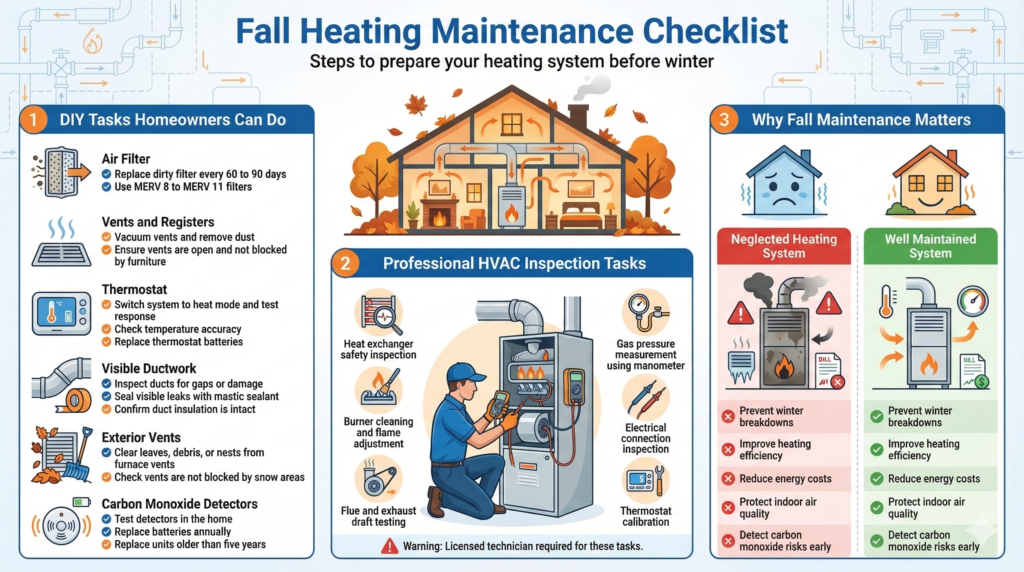
DIY Tasks Every Idaho Falls Homeowner Can Handle
You do not need to be an HVAC technician to complete these steps. Work through this list each fall before your heating system goes into heavy use.
Air Filter
- Check the current filter and replace if visibly dirty or if it has been in use for more than 60 to 90 days
- Use a MERV 8 to MERV 11 rated filter for a good balance between air quality and airflow
- Note the replacement date on the filter frame or set a phone reminder for the next change
Vents and Registers
- Vacuum dust and debris from all supply and return vents throughout the home
- Make sure no furniture, rugs, or curtains are blocking airflow to or from any register
- Walk through each room and confirm every vent is open closing vents in unused rooms does not save energy and can actually unbalance the system
Thermostat
- Switch the system to heat mode and confirm it engages the furnace within a few minutes of setting a call for heat
- Check whether the temperature reading matches a separate thermometer placed nearby
- Replace thermostat batteries if applicable
Visible Ductwork
- Inspect accessible ducts in utility areas, crawl spaces, and attics for obvious gaps, disconnections, or signs of damage
- Seal visible leaks with mastic sealant Idaho Power specifically recommends mastic over standard duct tape for durable sealing
- Check that insulation around ducts in unheated spaces such as attics is intact
Exterior Vents and Exhaust Pipes
- Walk around the exterior of the home and locate furnace combustion air intakes and exhaust vents
- Clear any leaves, debris, insect nests, or rodent materials from around and inside these openings
- Confirm vents are not obstructed by snow drift areas or landscaping that has grown over summer
Carbon Monoxide Detectors
- Test every carbon monoxide detector in the home by pressing the test button
- Replace batteries in all detectors as part of your fall routine
- Replace any detector that is more than five years old detector sensors degrade over time and older units may not trigger reliably
For more detail on testing your detectors properly, see our guide: Is My Carbon Monoxide Detector Working?
What Your Licensed HVAC Technician Should Inspect
The following tasks require professional training, specialized tools, and safety credentials. Do not attempt these without proper certification.
A qualified fall furnace tune-up from a licensed HVAC contractor should include:
- Heat exchanger inspection Cracks in the heat exchanger allow combustion gases, including carbon monoxide, to mix with circulated air. This is a critical safety check that requires a trained eye and often combustion analysis equipment.
- Burner cleaning and inspection Burners collect dust, oxidation, and combustion residue over a full heating season. A technician cleans and adjusts them for efficient, even flame.
- Gas pressure verification Pressure that is too low or too high affects combustion efficiency and heating output. A technician uses a manometer to confirm correct operating pressure.
- Electrical connection inspection All wiring connections are checked and tightened. Loose connections increase electrical resistance, raise energy consumption, and create fire risk.
- Blower motor and belt check The blower motor moves heated air through your ductwork. A technician checks motor operation, lubrication, and belt condition where applicable.
- Flue and draft inspection Combustion gases must exhaust properly through the flue. Blockages or improper draft can introduce carbon monoxide into the home.
- Thermostat calibration Technicians verify thermostat accuracy and confirm proper communication with the furnace control board.
“A heat exchanger crack is one of the most dangerous conditions we find during fall inspections and one of the most commonly missed by homeowners who skip professional maintenance. There are no symptoms you can reliably detect without a proper inspection. By the time a family notices something is wrong, they may already have elevated CO levels in the home.”
Dr. Thomas Vega, Indoor Air Quality Researcher and Certified Industrial Hygienist (CIH)
How Often Should You Change Your Furnace Filter in Idaho Falls?
Filter replacement is the single most impactful piece of ongoing heating maintenance a homeowner can perform. A clogged filter restricts airflow, causes the blower motor to overwork, reduces heating efficiency, and degrades indoor air quality all at the same time.
For most Idaho Falls homes, the recommended schedule is:
| Filter Type | Replacement Frequency |
| Standard 1-inch fiberglass | Every 30 days |
| Pleated 1-inch MERV 8-11 | Every 60 to 90 days |
| Thick media filter (4-5 inch) | Every 6 to 12 months |
| Homes with pets or allergies | Every 30 to 45 days regardless of type |
During winter in Idaho Falls, when the furnace is running many hours per day, filters accumulate debris more quickly than in mild seasons. Checking your filter monthly from November through February is a reliable habit.
For a complete guide, see: How Often to Change Your Air Filter for Peak Performance
Is Your Thermostat Ready for Winter? How to Check and Optimize Settings
Your thermostat controls every heating cycle in your home. A poorly calibrated or outdated thermostat can cause your furnace to run more than necessary, short-cycle, or heat unevenly all of which raise energy bills without improving comfort.
What Temperature Should You Set in Winter?
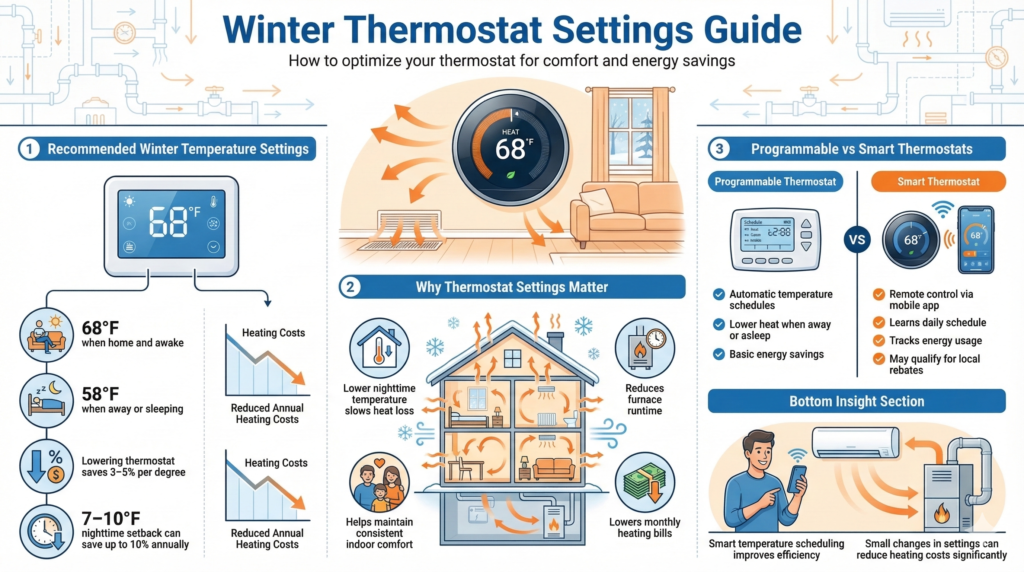
Idaho Power recommends setting your thermostat to 68°F when you are home and awake, and lowering it to 58°F when you are away or sleeping. According to Idaho Power’s published energy-saving guidance, each degree you lower the thermostat in winter saves approximately 3 to 5% on your heating costs.
The U.S. Department of Energy adds that setting the thermostat back 7 to 10 degrees for 8 hours per day such as overnight can save homeowners up to 10% annually on heating and cooling combined. For an Idaho Falls homeowner paying $150 per month in winter heating costs, that represents meaningful savings every season.
“The most common thermostat mistake we see is homeowners keeping a constant temperature day and night thinking it saves energy. Physically, that is incorrect. Your home loses heat at a rate proportional to the temperature difference between inside and outside. When you lower the setpoint at night, you slow that heat loss significantly. The savings are real.”
Marcus Webb, Energy Efficiency Consultant and member of the Building Performance Institute (BPI)
For tips on reducing your overall heating bill this season, read: How to Lower Your Heating Bill This Winter
Programmable vs. Smart Thermostats for Idaho Winters
Standard manual thermostats leave energy savings on the table. Programmable thermostats allow you to set temperature schedules that automatically reduce heating when you are at work or asleep. Smart thermostats go further, learning your schedule, providing remote control via smartphone, and tracking energy usage over time.
Idaho Power offers cash incentives for qualifying Idaho homeowners who upgrade to smart thermostats particularly for homes with electric furnaces or heat pump systems. If you have a heat pump rather than a gas furnace, note that smart thermostat settings for heat pumps should maintain a narrower temperature range to avoid triggering less efficient backup resistance heat.
What Does a Professional Heating Tune-Up Include?
A professional HVAC maintenance appointment goes well beyond what a homeowner can accomplish independently. Here is what a thorough fall furnace tune-up from a licensed Idaho Falls HVAC contractor should cover:
Heat Exchanger and Carbon Monoxide Safety Checks
The heat exchanger is the most safety-critical component in a gas furnace. It is the barrier between combustion gases and the air circulated through your home. A cracked heat exchanger allows carbon monoxide an odorless, colorless gas to enter your living spaces.
Carbon monoxide poisoning accounts for more than 400 deaths per year in the United States, according to the Centers for Disease Control and Prevention (CDC). A professional heat exchanger inspection during fall maintenance is your primary line of defense. Technicians use visual inspection, combustion analysis, and sometimes smoke or gas detection tools to identify cracks or failures.
Learn more about carbon monoxide safety in your home: Is My Carbon Monoxide Detector Working?
Burner Cleaning, Gas Pressure, and Electrical Connections
Clean burners produce an even, blue flame that combusts fuel efficiently. Dirty or partially blocked burners produce an irregular flame, increase fuel consumption, and can create elevated carbon monoxide output. A technician cleans each burner and inspects the flame pattern during your tune-up.
Gas pressure verification ensures the furnace is receiving fuel at the correct operating pressure. Too little pressure results in poor heating output. Too much pressure creates excess heat and can damage components over time.
Electrical connection checks protect against both safety hazards and inefficiency. Loose connections create resistance at the connection point, which generates heat and increases energy use. Tightening all connections is a standard part of any competent furnace tune-up.
“Annual maintenance is not optional from a warranty standpoint for most major furnace brands. If a heat exchanger fails after five years and there is no documented record of annual professional service, the manufacturer will typically deny the warranty claim. The tune-up pays for itself in warranty protection alonebefore you even count energy savings or avoided repairs.”
Sandra Okafor, Certified HVAC Systems Technician (NATE-certified) with specialization in residential gas heating systems
For a deeper look at how your furnace’s heat exchanger works, read: Understanding Heat Exchangers and How They Work
When Is It Time to Repair vs. Replace Your Furnace?
Seasonal maintenance sometimes reveals that a furnace is near the end of its useful life. Most gas furnaces last 15 to 20 years with regular care. If your system is approaching or past that range, a significant repair bill prompts a legitimate question: is it worth fixing?
A widely used rule of thumb in the HVAC industry is the 5,000 rule. Multiply the age of the furnace by the estimated repair cost. If the result exceeds $5,000, replacement is generally the better financial decision. A 12-year-old furnace facing a $450 repair scores 5,400 suggesting replacement deserves serious consideration. A 5-year-old furnace with the same repair scores only 2,250, clearly worth repairing.
Other signals that suggest replacement over repair:
- Heating bills have increased noticeably over the past two to three seasons without a change in usage habits
- The system is short-cycling turning on and off more frequently than it used to
- Some rooms are consistently warmer or colder than others
- The furnace requires repairs more than once per heating season
- Your system uses R-22 refrigerant or other phased-out components
For a full analysis specific to Idaho Falls homeowners, read: When to Repair vs. Replace Furnace in Idaho Falls
Ready to Schedule Your Seasonal Heating Tune-Up in Idaho Falls?
Completing your seasonal heating maintenance checklist before winter arrives is one of the best decisions you can make as a homeowner in Idaho Falls. It protects your family’s safety, keeps your energy bills in check, and extends the life of one of the most important and expensive systems in your home.
The benefits of regular HVAC maintenance go well beyond a single season. Homeowners who stay consistent with annual professional service experience fewer emergency breakdowns, lower average repair costs, and better indoor air quality year-round.
Ridgeline Heating and Cooling serves Idaho Falls and the surrounding communities with reliable, honest heating maintenance, repair, and installation. Our licensed HVAC technicians know the demands of this climate and are ready to get your system prepared for whatever this winter brings.
Contact Ridgeline Heating and Cooling today to schedule your fall furnace tune-up. Do not wait until the first hard freeze to find out your heating system has a problem.


