Skip to content



The best energy-efficient HVAC upgrades for Idaho Falls homeowners are heat pumps, ductless mini-split systems, and smart thermostats. These upgrades can reduce your heating and cooling costs by 30 to 60 percent, and federal tax credits through the Inflation Reduction Act let you claim up to $3,200 back. Idaho Falls Power also offers zero-interest loans for qualifying equipment.
Key Takeaways
- Heat pumps and mini-splits can cut your energy use by up to 60% compared to older electric systems
- Federal tax credits under the Inflation Reduction Act cover up to $2,000 for heat pump installations through 2032
- Idaho Falls Power offers zero-interest loans and rebates for air-source, ground-source, and ductless heat pumps
- A smart thermostat alone can trim 10 to 15% off your annual heating and cooling bill
- Eastern Idaho’s extreme temperature swings make efficient HVAC equipment more valuable here than in milder climates
What Are the Best Energy-Efficient HVAC Upgrades for Idaho Falls Homes?
Energy-efficient HVAC upgrades fall into three main categories: replacing your primary heating and cooling equipment, adding zone-specific systems, and installing smart controls. Each option works differently depending on your home’s size, existing ductwork, and budget. Here is a breakdown of what works best for homes in eastern Idaho.
Heat Pump Installation
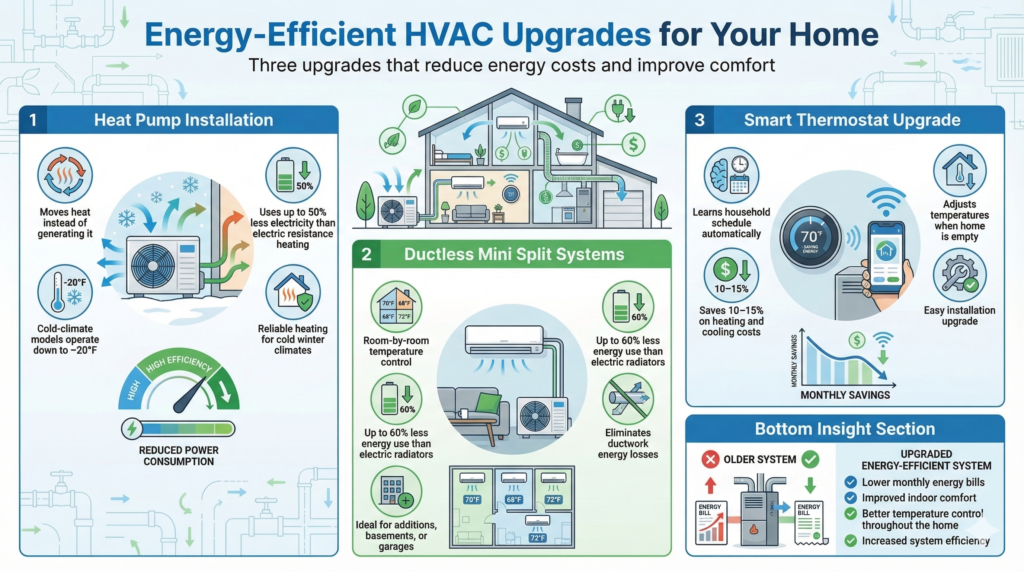
A heat pump is one of the most cost-effective upgrades available to Idaho Falls homeowners. Unlike a furnace that burns fuel to generate heat, a heat pump moves heat from outside air into your home, requiring far less energy to do the same job. According to the U.S. Department of Energy, modern air-source heat pumps can reduce electricity use for heating by approximately 50% compared to electric resistance heating like baseboard heaters.
Cold-climate heat pump models, sometimes labeled “Hyper-Heat” by manufacturers, maintain effective performance down to -20 degrees Fahrenheit. That makes them a reliable choice for Idaho Falls winters, where temperatures regularly drop below freezing from November through February.
“The technology in cold-climate heat pumps has advanced dramatically. Homeowners in northern states and mountain regions who dismissed heat pumps a decade ago should take a fresh look. These systems now deliver reliable comfort even during the coldest nights of the year.” – Michael Bluejay, Energy Efficiency Expert and Author, MichaelBluejay.com
Ductless Mini-Split Systems
A ductless mini-split is a heat pump system without the ductwork. One outdoor unit connects to one or more indoor units mounted on the wall, giving you precise, room-by-room temperature control. According to ENERGY STAR, certified mini-splits use up to 60% less energy than standard home electric radiators.
Mini-splits are especially practical for Idaho Falls homes with additions, finished basements, or garage spaces that sit outside the reach of your central system. Because they eliminate ductwork, they also avoid the energy losses that ducted systems carry. Research from ASHRAE found that ductwork energy losses can account for 20 to 30% of a home’s total space conditioning energy use.
“Ductless mini-splits are one of the fastest-growing HVAC categories in North America for good reason. They give homeowners granular control over comfort in each room without the cost and energy waste of conditioning unused spaces.” – Chris Dorsi, Founder, Heat Pump Store and Author of ‘The Heat Pump Book’
Thinking about whether a ductless system fits your home? Read our detailed guide on mini-split systems for your home to compare options and costs.
Smart Thermostat Upgrades
A smart thermostat is the most affordable energy-efficient upgrade you can make today. By learning your schedule and adjusting temperatures automatically, a smart thermostat reduces the amount of time your system runs when no one is home. The U.S. Environmental Protection Agency estimates that smart thermostat users save an average of 10 to 15% on heating and cooling costs annually.
Smart thermostats also pair well with heat pumps and mini-splits, extending the efficiency gains of those systems by eliminating unnecessary run cycles. Installation typically takes under an hour, and most models cost between $100 and $250 before any rebates.
Need this handled in Idaho Falls? See our high-efficiency furnace installation page or call (208) 521-2041.
Quick Comparison: Energy-Efficient HVAC Upgrades at a Glance
Use this table to compare savings potential and available incentives for the most popular upgrades for Idaho Falls homeowners.
| Upgrade | Avg. Energy Savings | Federal Tax Credit | Idaho Falls Power Incentive |
| Air-Source Heat Pump | Up to 50% | Up to $2,000 | Rebate + Zero-Interest Loan |
| Ductless Mini-Split | Up to 60% vs. electric radiators | Up to $2,000 | Zero-Interest Loan Available |
| Smart Thermostat | 10-15% on heating and cooling | Up to $150 | Varies by program |
| High-Efficiency Furnace | 15-30% vs. older units | Up to $600 | Check with Idaho Falls Power |
Why Do Idaho Falls Homes Need Efficient Heating and Cooling More Than Most?
Idaho Falls sits at roughly 4,700 feet in elevation, placing it in a cold semi-arid climate with hot summers and cold winters. Average January lows hover around 14 degrees Fahrenheit, while July highs reach into the low 90s. That swing of nearly 80 degrees means your HVAC system works hard in both directions every year.
Extreme Temperature Swings in Eastern Idaho
According to data from the National Oceanic and Atmospheric Administration (NOAA), Idaho Falls averages 176 heating degree days per month in January alone. That sustained cold demand places a heavy load on any heating system that is not running efficiently. Every percentage point of efficiency improvement translates directly into dollars saved across a long Idaho winter.
“In high-altitude, cold-climate markets like eastern Idaho, homeowners consistently report the highest ROI from heat pump upgrades. The combination of heating demand, available federal incentives, and local utility rebates makes this one of the strongest cases for upgrading in the country.” – Allison Bailes III, PhD, Building Science Expert and Author of ‘A House Needs to Breathe… Or Does It?’
How an Aging System Quietly Drains Your Wallet
An HVAC system older than 10 to 15 years loses efficiency every year, even if it still turns on without issue. A furnace installed in 2005 may have had an 80% Annual Fuel Utilization Efficiency (AFUE) rating when new. By comparison, modern high-efficiency furnaces carry AFUE ratings of 96% or higher, meaning they convert nearly all of their fuel into useful heat.
For more on when a repair is no longer worth the cost, see our guide on when to repair vs. replace your furnace in Idaho Falls.
What Financial Incentives Are Available for Idaho Falls HVAC Upgrades?
Idaho Falls homeowners upgrading to energy-efficient HVAC equipment in 2026 have access to federal tax credits, local utility rebates, and state financing programs that can significantly reduce the upfront cost of a new system. Combining multiple incentives is both allowed and encouraged.
Federal Tax Credits Under the Inflation Reduction Act
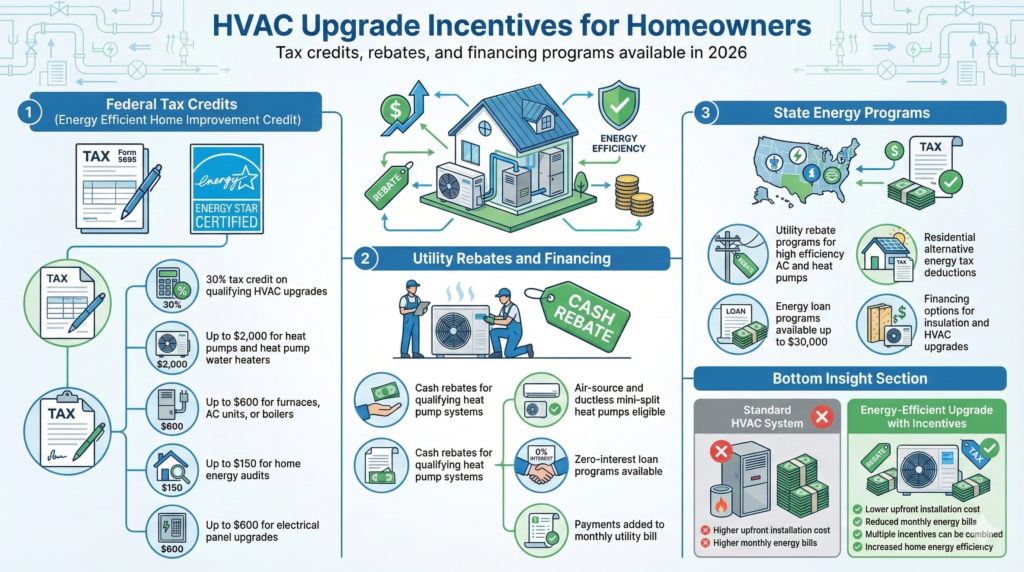
The Energy Efficient Home Improvement Credit (25C) under the Inflation Reduction Act allows homeowners to claim 30% of the cost of qualifying HVAC equipment, up to an annual limit of $3,200. Specific caps within that limit include:
- Heat pumps and heat pump water heaters: Up to $2,000
- Air conditioners, furnaces, and boilers: Up to $600
- Home energy audits: Up to $150
- Electrical panel upgrades: Up to $600
To claim the credit, file IRS Form 5695 with your tax return. Equipment must meet ENERGY STAR certification standards to qualify. Learn more about which systems apply in our full guide on HVAC tax incentives in Idaho Falls.
Idaho Falls Power Rebates and Zero-Interest Loans
Idaho Falls Power offers both cash rebates and zero-interest loans for residential customers who install qualifying heat pump equipment. Eligible systems include air-source heat pumps, ground-source heat pumps, and ductless mini-split heat pumps.
The zero-interest loan program lets customers spread the cost of installation across their monthly utility bill with no added interest, provided they have 12 months of on-time payment history with Idaho Falls Power. This removes the biggest barrier for homeowners who want to upgrade but cannot cover the full upfront cost.
Rocky Mountain Power and State Programs
Homeowners served by Rocky Mountain Power can access cash rebates through the Wattsmart program for high-efficiency central air conditioners and air-source heat pumps. Idaho also offers a Residential Alternative Energy Tax Deduction and a low-interest Energy Loan Program offering up to $30,000 at a maximum 7% interest rate for qualifying upgrades including heat pumps and insulation.
For a complete breakdown of every available incentive, visit our dedicated page on HVAC tax credits and rebates for 2026.
How Do You Know When It’s Time to Upgrade Your HVAC System?
Knowing when to upgrade is just as important as knowing what to upgrade to. An HVAC system that is technically operational but running inefficiently costs you money every month without delivering the comfort a newer system would. Here are the two clearest signals that it is time to act.
System Age and Repair Frequency
The general rule of thumb used by licensed HVAC contractors is the 5,000 rule: multiply the age of your system by the cost of the repair. If that number exceeds $5,000, replacement usually makes better financial sense than continuing to repair. A system older than 15 years combined with a $400 repair bill crosses that threshold.
“When a homeowner calls us for their third repair in two years on a system that’s more than 12 years old, we have an honest conversation about the math. In most cases, a new high-efficiency system pays for itself within five to eight years through energy savings alone, especially with today’s incentive programs.” – Ridgeline Heating and Cooling, Idaho Falls, ID
Rising Energy Bills With No Clear Cause
If your heating and cooling costs have increased noticeably over the past two or three winters with no change in usage habits, your system may be losing efficiency. Dirty coils, worn compressors, and refrigerant issues can all reduce system output gradually. A professional HVAC maintenance inspection can identify whether the issue is repairable or whether a replacement would deliver better long-term value.
If rising bills are your main concern right now, our resource on how to lower your heating bill this winter covers several practical steps you can take while you plan a larger upgrade.
What Should You Expect During an Energy-Efficient HVAC Installation?
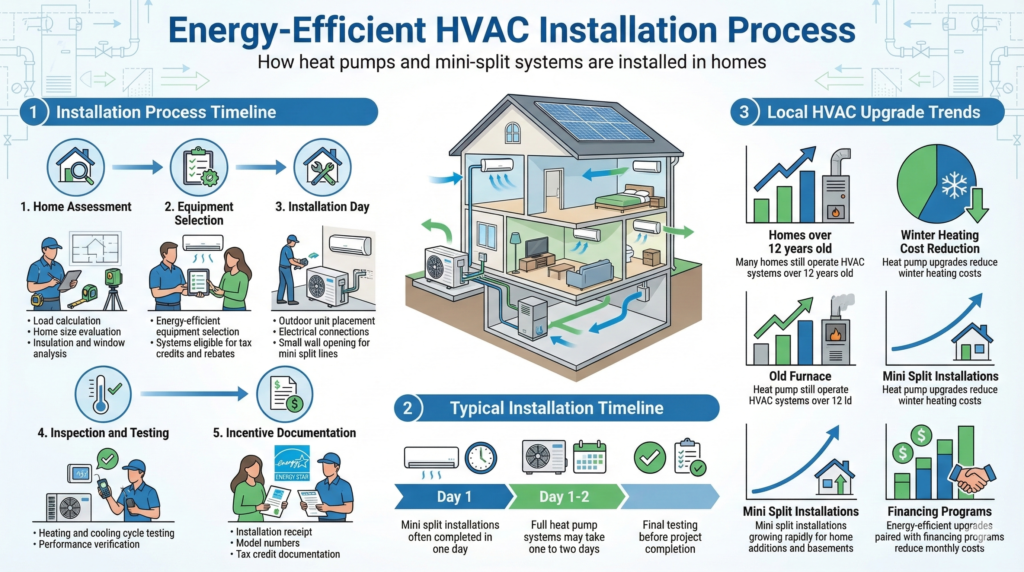
For most Idaho Falls homeowners, a heat pump or mini-split installation is a one to two day process. Here is what a standard installation looks like from start to finish when you work with a licensed HVAC contractor.
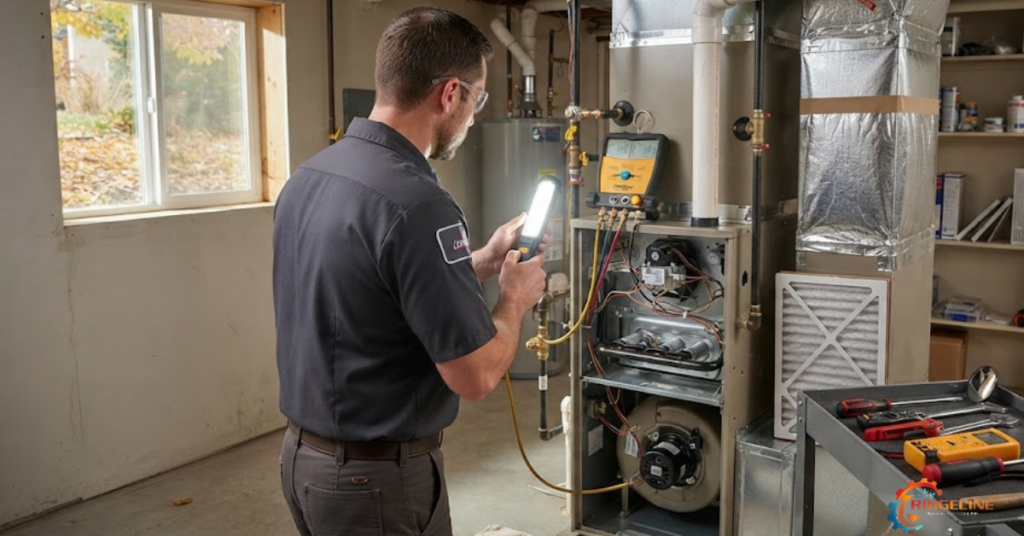
- Home assessment: Your contractor performs a load calculation to size the system correctly for your home’s square footage, insulation level, and window layout.
- Equipment selection: Based on the assessment, your contractor recommends equipment that qualifies for available federal tax credits and local rebates.
- Installation day: For a mini-split, installation requires only a small hole in an exterior wall. A full heat pump installation may take one full day, including outdoor unit placement and electrical connection.
- Inspection and testing: Your contractor tests the system through a full heating and cooling cycle before completing the job.
- Incentive documentation: Your contractor provides the installation receipt, equipment model numbers, and ENERGY STAR certification details you will need to file for tax credits and utility rebates.
Important note: For Idaho Falls Power zero-interest loans, your contractor must submit a bid to Idaho Falls Power’s Energy Services Department before installation begins. Do not wait until after the job is complete to apply.
Ridgeline Local Data: What We See in Idaho Falls Homes
Based on HVAC assessments conducted by Ridgeline Heating and Cooling across Idaho Falls and Bonneville County in 2024-2025:
- Approximately 68% of homes we assess are running HVAC equipment older than 12 years
- Homeowners who upgrade to heat pumps report average monthly savings of $80-$140 during peak heating months (December-February)
- Mini-split installations in home additions and finished basements are the fastest-growing upgrade request we receive, up roughly 40% since 2022
- Over 90% of customers who combined a heat pump upgrade with Idaho Falls Power’s zero-interest loan program reported the monthly loan payment was fully offset by their reduced utility bill
What Idaho Falls Homeowners Are Saying
Real feedback from homeowners in the Idaho Falls area who have upgraded their HVAC systems with Ridgeline Heating and Cooling.
“We replaced our 18-year-old furnace with a heat pump last fall. Our heating bill dropped from $210 a month to $118 the first December. The Idaho Falls Power loan made it easy to say yes. Ridgeline walked us through everything.” – Jennifer M., Idaho Falls, ID
“I had a mini-split installed in my finished garage and a second one upstairs. The difference in comfort is night and day. Both qualified for the federal tax credit which helped a lot with the cost.” – Travis K., Ammon, ID
“Ridgeline did a full home assessment before recommending anything. They did not try to oversell us. We ended up with a smart thermostat and a tune-up on our existing system, and our bills came down right away.” – Sandra R., Idaho Falls, ID
Ready to Lower Your Energy Bills in Idaho Falls?
Upgrading your HVAC system is one of the highest-return investments an Idaho Falls homeowner can make, especially with today’s federal tax credits and local utility incentives reducing the upfront cost. Whether you are interested in a full heat pump installation, a ductless mini-split for a specific area of your home, or simply starting with a smart thermostat, every step toward greater efficiency puts money back in your pocket.
At Ridgeline Heating and Cooling, we help Idaho Falls homeowners choose the right system, navigate every available incentive program, and deliver professional installation you can count on for years to come. Contact us today to schedule a free home assessment and find out exactly how much you could save.
Have questions about your current system before making a decision? Our team is ready to help. Call us or schedule your visit online.
Ready to upgrade?
From 96 percent AFUE furnaces to cold-climate heat pumps, we install the equipment that qualifies for current rebates. Start with high-efficiency furnace installation or a heat pump consultation.
Call (208) 521-2041 or request service online. Ridgeline Heating and Cooling, 370 College St, Idaho Falls, ID 83401.