 Skip to content




The best air purification systems for Idaho Falls homes combine a MERV 13 HVAC filter for whole-house baseline filtration with a portable True HEPA air purifier in high-use rooms like bedrooms. This layered approach captures up to 99.97% of airborne particles, including wildfire smoke, pollen, pet dander, and mold spores that are common across eastern Idaho. Whether you are dealing with summer smoke season or winter inversion events, the right air purification setup protects your family’s respiratory health year-round.
Key Takeaways
- Idaho Falls homeowners face wildfire smoke, winter inversions, and seasonal allergens that make air purification essential for respiratory health
- Whole-house air purifiers integrate with your HVAC system and clean every room, while portable HEPA units provide targeted room-level protection
- MERV 13 is the highest-rated filter most residential HVAC systems can handle without restricting airflow
- True HEPA filters capture 99.97% of particles at 0.3 microns, compared to approximately 50% for MERV 13 at the same particle size
- Installation costs for whole-house air purification systems typically range from $1,000 to $3,000
Why Do Idaho Falls Homes Need Air Purification Systems?
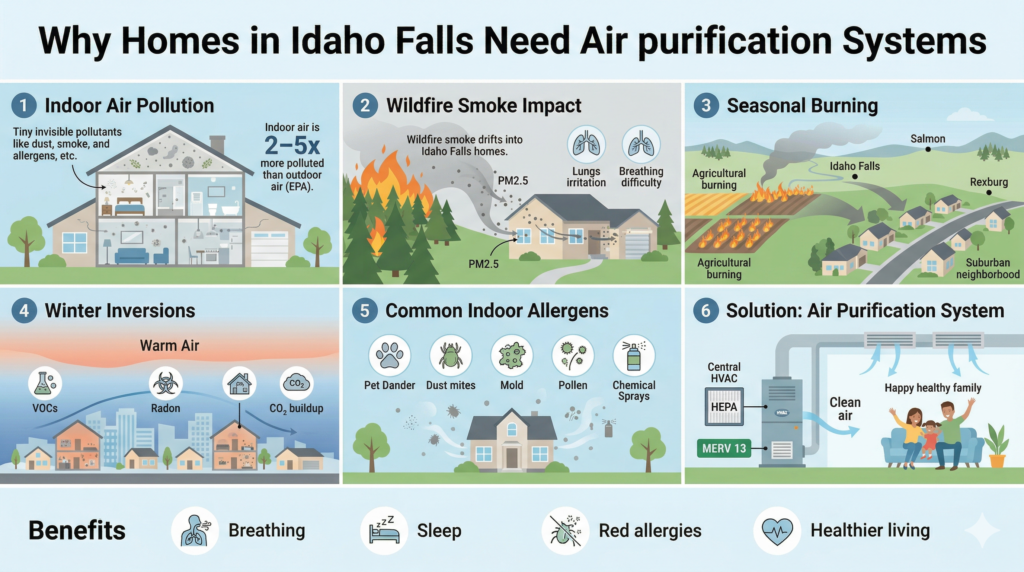
Indoor air in most American homes contains two to five times more pollutants than outdoor air, according to the U.S. Environmental Protection Agency. For Idaho Falls residents, this problem is compounded by regional air quality challenges that push harmful particles into homes throughout the year. Nearly 131 million Americans now live in areas with failing air quality grades, making air purification a priority for health-conscious homeowners.
Wildfire Smoke and Seasonal Air Quality Alerts in Eastern Idaho
The Idaho Falls region generally has good air quality, but seasonal burning activities and wildfires can significantly impact the area. The Idaho Department of Environmental Quality reports that prescribed and agricultural burning have impacted Idaho Falls, Salmon, and Rexburg, where air pollutants are actively monitored during spring and fall months. Eastern Idaho also manages one of the largest crop residue burning programs in the state.
During wildfire season, fine particulate matter (PM2.5) drifts indoors and irritates lungs, creating both short-term and long-term health risks. Standard home air filters do not capture PM2.5 particles effectively, which is why the Idaho Department of Health and Welfare recommends using HEPA purifiers or HVAC filters rated MERV 13 or higher to remove dust, pollen, and small particles during smoke events.
Winter Inversions Trap Pollutants Inside Your Home
Idaho Falls experiences temperature inversions during winter months, where cold air becomes trapped under a layer of warmer air. These inversions prevent pollutants from dispersing and can cause outdoor air quality to deteriorate rapidly. During inversion events, keeping windows closed traps pollutants like radon, volatile organic compounds (VOCs), and carbon dioxide inside the home.
Dr. John Balmes, Professor of Medicine at the University of California San Francisco and a physician member of the California Air Resources Board, has noted that prolonged exposure to trapped indoor air pollutants during inversion events can aggravate asthma, trigger allergic reactions, and contribute to cardiovascular stress, especially in vulnerable populations like children and older adults.
The Idaho Department of Health and Welfare advises homeowners to keep humidity between 30% and 50%, replace HVAC filters regularly, and use quality air purifiers during these events. An effective air purification system becomes your home’s first line of defense when outdoor conditions make natural ventilation impractical.
Common Indoor Allergens in Idaho Homes
Idaho Falls homes contend with a range of indoor allergens beyond wildfire smoke and inversions. Pet dander, dust mites, mold spores, pollen, and VOCs from cleaning products and furniture off-gassing are all common triggers. The average American spends roughly 90% of their time indoors, which means even small concentrations of these pollutants add up to significant exposure over time.
A quality air purification system captures these particles before they circulate through your living spaces, reducing allergy symptoms, improving sleep quality, and creating a cleaner home environment overall.
What Types of Air Purification Systems Are Available for Your Home?
Air purification systems for residential use fall into several categories, each with different strengths. Understanding these options helps you choose the right fit for your Idaho Falls home’s size, budget, and air quality needs.
Whole-House Air Purifiers (HVAC-Integrated)
A whole-house air purifier integrates directly into your existing HVAC ductwork, cleaning the air throughout your entire home whenever your heating or cooling system runs. Unlike portable units that target a single room, whole-house systems filter every cubic foot of air that passes through your ducts.
Whole-house systems typically use high-MERV media filters or advanced filtration technologies like photocatalytic oxidation (PCO). For example, the Lennox PureAir system is one of the only single indoor air quality systems designed to combat all three classes of indoor air contaminants: particulates, bioaerosols, and volatile organic compounds. Some premium systems, like the IQAir PerfectPro, offer filtration down to 0.003 microns and can cycle your home’s air up to 125 times per day.
Whole-house air purifiers are ideal for families who want consistent air quality in every room without managing multiple portable units.
Portable HEPA Air Purifiers
Portable air purifiers with True HEPA filters are standalone units designed to clean the air in a single room. A True HEPA filter must capture at least 99.97% of particles at 0.3 microns in size, which includes pollen, mold spores, dust mites, pet dander, bacteria, and some viruses.
Steve Fontaine, founder of IAQ Solutions & Consulting Inc. and a nationally recognized indoor air quality specialist who has helped place over 1.2 million air purifiers in schools and public buildings, recommends standalone HEPA purifiers as an effective and accessible solution for households dealing with respiratory concerns. Portable units work especially well in bedrooms, home offices, and nurseries where you spend concentrated amounts of time.
Top-performing portable models in 2025 and 2026 testing include the Levoit Core 600S, the Coway Airmega AP-1512HH, and the Winix 5500-2. When selecting a portable unit, look for a high Clean Air Delivery Rate (CADR) matched to your room’s square footage and a noise level under 40 dB for bedroom use.
If you are comparing specific IAQ products for your HVAC system, check out our Air Ranger vs Air Scrubber comparison for a detailed breakdown.
UV-Light Germicidal Systems
UV-light air purification systems are installed inside your HVAC ductwork or near the evaporator coil. They use ultraviolet-C (UVC) light to neutralize bacteria, viruses, mold, and other biological contaminants as air passes through the system. UV systems are particularly effective at keeping the AC coil free of organic buildup, which helps your HVAC system run more efficiently and reduces maintenance costs.
UV-light systems work best as a complement to mechanical filtration rather than a replacement. They neutralize biological threats but do not remove particulate matter like dust, pollen, or smoke from the air. Pairing a UV system with a MERV 13 filter and a portable HEPA unit gives you comprehensive coverage against all major indoor air quality threats.
Activated Carbon Filters for Smoke and Odors
Activated carbon filters absorb gases, odors, and volatile organic compounds that HEPA and MERV filters cannot capture. These filters use a bed of porous carbon material to trap chemical vapors from cooking, cleaning products, paint, furniture off-gassing, and wildfire smoke odors.
For Idaho Falls homeowners dealing with seasonal smoke, a purifier that combines True HEPA filtration with an activated carbon layer provides the most complete protection. The HEPA filter captures fine particulate matter while the carbon filter neutralizes the smoky smell and chemical compounds associated with wildfire events.
How Do MERV Ratings Compare to HEPA Filters?
Understanding the difference between MERV-rated filters and HEPA filters is essential for choosing the right air purification strategy for your home. Both serve important roles, but they work differently and are designed for different applications within your HVAC setup.
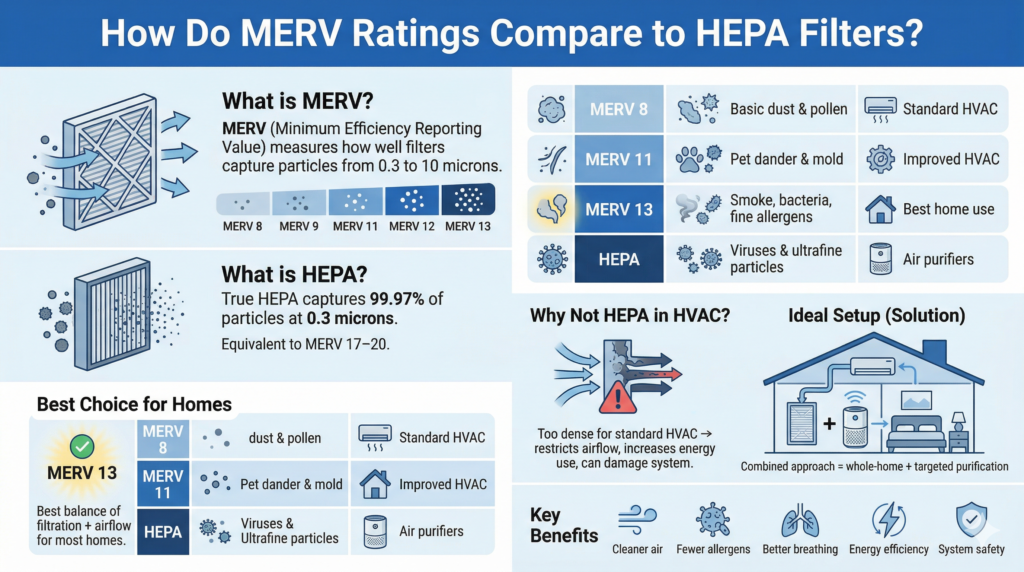
HEPA (High Efficiency Particulate Air) filters must capture at least 99.97% of particles at 0.3 microns to earn the True HEPA designation. HEPA filters correspond roughly to MERV 17 through 20 on the rating scale.
MERV stands for Minimum Efficiency Reporting Value, a rating system developed by the American Society of Heating, Refrigerating and Air-Conditioning Engineers (ASHRAE). The EPA defines MERV ratings as a measure of a filter’s ability to capture particles between 0.3 and 10 microns. Higher MERV numbers mean better filtration.
| Filter Type | Particle Capture at 0.3 Microns | Best For | Typical Use |
| MERV 8 | 20% or less | Basic dust and pollen | Standard residential HVAC |
| MERV 11 | ~65% of 1.0-3.0 micron particles | Pet dander, mold spores | Upgraded residential HVAC |
| MERV 13 | ~50% at 0.3 microns; 90%+ at 1.0+ microns | Bacteria, smoke particles, fine allergens | Best residential HVAC option |
| True HEPA | 99.97% at 0.3 microns | Viruses, ultrafine particles, medical-grade needs | Portable air purifiers |
What MERV Rating Should Idaho Falls Homeowners Use?
For most Idaho Falls homes, a MERV 13 filter represents the best balance between filtration performance and HVAC system compatibility. MERV 13 captures over 90% of larger particles like pollen and pet dander and approximately 50% of particles at the critical 0.3-micron size, which includes some bacteria and smoke particles.
ASHRAE’s Standard 62.2-2025 provides ventilation and indoor air quality guidelines for residential buildings, recommending adequate air filtration as part of a comprehensive IAQ strategy. The standard emphasizes that proper filtration should be matched to your system’s airflow capacity to avoid creating excessive pressure drops.
Moving beyond MERV 13 in a standard residential system typically creates more problems than it solves. Higher-rated filters restrict airflow, which can strain your blower motor, spike energy bills, and reduce your HVAC system’s heating and cooling performance.
Can You Install a HEPA Filter in a Standard HVAC System?
In most cases, no. Standard residential HVAC systems are not built to push air through the dense media of a True HEPA filter. Installing a HEPA filter directly into your furnace or air handler can restrict airflow to the point where the system overheats, short-cycles, or fails to adequately heat and cool your home.
The practical solution is to use a MERV 13 filter in your HVAC system for whole-house baseline filtration and add a portable True HEPA air purifier in the rooms where you spend the most time. This combined approach gives you near-complete particle removal without risking damage to your heating and cooling equipment.
What Is the Best Air Purification Setup for an Idaho Falls Home?
The most effective air purification strategy for Idaho Falls homeowners is a layered approach that combines whole-house filtration with targeted room-level purification. This setup addresses the full spectrum of indoor air quality threats without overloading your HVAC system.
The Combined MERV 13 + Portable HEPA Approach
Here is how to set up a comprehensive air purification system for your home:
- Install a MERV 13 pleated filter in your HVAC system. This filter acts as your first line of defense, cleaning the air every time your furnace or air conditioner runs. It captures the majority of pollen, dust, pet dander, and mold spores circulating through your ductwork.
- Place a portable True HEPA air purifier in your bedroom. Since you spend approximately eight hours per night in this room, adding HEPA-level filtration here significantly reduces your exposure to fine particles during sleep.
- Consider a second portable unit for your main living area. If your household includes allergy sufferers, young children, or pets, a second HEPA purifier in the living room or family room provides an additional layer of protection.
- Add activated carbon filtration during wildfire season. Choose portable units with both HEPA and activated carbon filters to handle both the fine particulate matter and the smoky odors that come with Idaho’s fire season.
- Schedule regular filter changes to keep your system running efficiently. Make sure to change your air filter regularly based on the manufacturer’s recommendations and your home’s specific conditions.
How to Size an Air Purifier to Your Room’s Square Footage
Choosing the right-sized air purifier is critical for effective filtration. An undersized unit will not clean your air fast enough, while an oversized unit wastes money on capacity you do not need.
Jeffrey May, a Certified Indoor Air Quality Professional and author of “My House Is Killing Me,” emphasizes that matching purifier capacity to room volume is one of the most overlooked steps in residential air quality improvement. Homeowners frequently purchase purifiers based on price rather than performance specifications, which leads to disappointing results.
Why CADR (Clean Air Delivery Rate) Matters
The Clean Air Delivery Rate (CADR) measures how much filtered air a purifier delivers per minute, rated separately for dust, smoke, and pollen. A higher CADR number means the unit can clean air faster. The industry standard recommends at least 4.8 air changes per hour (ACH) for adequate room coverage.
To find the right CADR for your room, calculate your room’s volume (length x width x height) and divide by the number of minutes in an hour. For example, a 300-square-foot room with 8-foot ceilings has 2,400 cubic feet of air. To achieve 4.8 ACH, you need a purifier with a CADR of at least 192 cubic feet per minute.
Smart air purifiers with built-in particle sensors now represent 67.20% of U.S. air purifier sales as of 2025, with homeowners making up 59.10% of the market. These units automatically adjust fan speed based on real-time air quality readings, ramping up during smoke events and dropping to quiet, energy-saving mode when the air is clean.
How Much Does a Whole-House Air Purification System Cost to Install?
Understanding the costs involved helps you budget for the right air purification solution and avoid surprises during the installation process.
Equipment and Installation Price Ranges
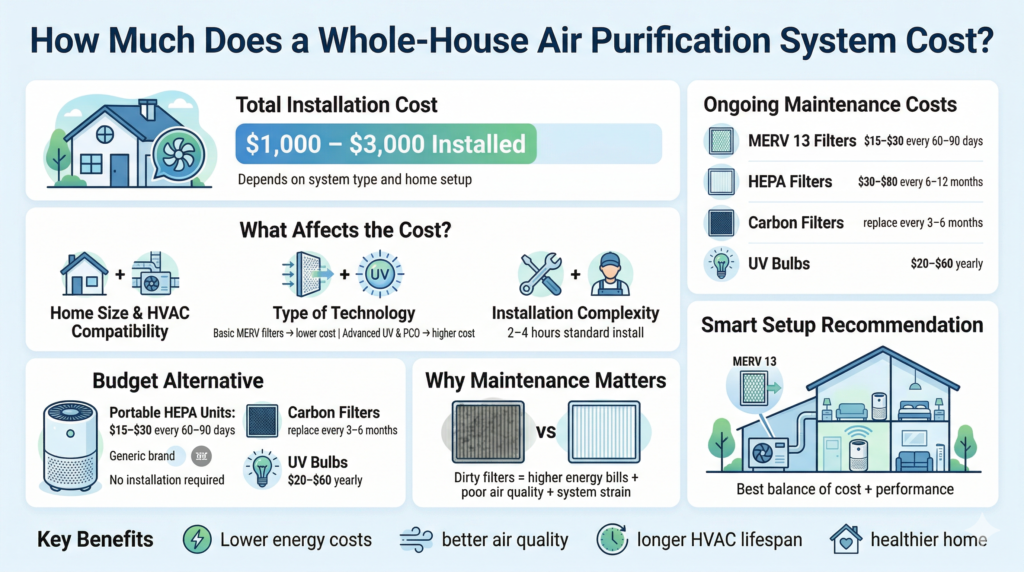
The cost to install a whole-house air purification system typically ranges from $1,000 to $3,000, according to Carrier’s residential air quality division. Several factors affect the final price:
- Home size and HVAC system compatibility. Larger homes and older systems may require additional modifications or higher-capacity units.
- Type of purification technology. Basic high-MERV media filter installations fall on the lower end, while advanced multi-stage systems with UV and PCO technology cost more.
- Installation complexity. Standard in-duct installations take approximately two to four hours, but homes with custom ductwork or accessibility challenges may take longer.
Portable HEPA air purifiers offer a lower-cost entry point. Quality mid-range models from brands like Levoit, Coway, and Winix typically cost between $150 and $400 per unit, with no professional installation required.
Long-Term Filter Replacement and Maintenance Costs
Budget for ongoing filter replacement costs when evaluating your air purification investment:
- MERV 13 HVAC filters: Replace every 60 to 90 days, costing roughly $15 to $30 per filter
- Portable HEPA filters: Replace every 6 to 12 months, costing $30 to $80 per replacement filter
- Activated carbon filters: Replace every 3 to 6 months for optimal odor and VOC removal
- UV-light bulbs: Replace annually, typically $20 to $60 per bulb
Consistent filter maintenance is just as important as the initial equipment investment. A clogged or expired filter forces your HVAC system to work harder, increases your energy bills, and reduces the air purification effectiveness you are paying for. Pairing your air purification system with regular HVAC maintenance ensures everything runs efficiently and lasts longer.
How Can You Keep Your Air Purification System Running at Peak Performance?
Even the best air purification system needs consistent maintenance to deliver clean air effectively. Following a simple maintenance routine protects your investment and keeps your indoor air quality at its best.
5-Step Air Purification Maintenance Checklist
- Check your MERV 13 HVAC filter every 30 days. Replace it every 60 to 90 days, or sooner if you have pets, live near construction, or are experiencing wildfire smoke conditions.
- Replace your portable HEPA filter on schedule. Most units have an indicator light, but check the manufacturer’s recommendation since filter life varies by model and usage.
- Clean the exterior and pre-filter of portable units monthly. Wipe down the housing and vacuum or rinse the washable pre-filter to maintain airflow.
- Inspect your ductwork annually. Leaky or dirty ducts reduce the effectiveness of your whole-house air purification system. Consider professional duct cleaning if you notice dust buildup, musty odors, or uneven airflow between rooms.
- Schedule professional HVAC maintenance twice per year. A certified technician can verify that your filtration system is properly seated, your ductwork is sealed, and your system is operating at peak efficiency.
When to Call a Licensed HVAC Contractor for Help
Contact a licensed HVAC professional if you experience any of the following:
- Reduced airflow from your vents after installing a new filter, which may indicate the filter is too restrictive for your system
- Persistent musty or stale odors despite running your air purification system, which could point to mold growth inside your ductwork
- Increased allergy symptoms even with air purification running, which may indicate ductwork leaks pulling in unfiltered air from attics or crawl spaces
- Unusual noises from your HVAC system after adding filtration components, which could signal airflow restrictions or mechanical strain
A professional can assess your system’s airflow, recommend the right filtration level, and install whole-house purification components safely and correctly.
Breathe Easier in Your Idaho Falls Home
Protecting your family’s indoor air quality does not have to be complicated. Start with a MERV 13 filter in your HVAC system for whole-house coverage, add a portable True HEPA purifier in your bedroom for targeted protection, and keep up with regular filter changes and system maintenance. This layered approach gives Idaho Falls homeowners the most effective defense against wildfire smoke, seasonal allergens, winter inversion pollutants, and everyday indoor contaminants.
If you are ready to improve the air quality in your home, Ridgeline Heating and Cooling can help. Our team installs and services air purification systems in Idaho Falls and the surrounding communities. We will assess your current HVAC setup, recommend the right filtration solution for your home’s size and needs, and handle the installation from start to finish.
Contact Ridgeline Heating and Cooling today to schedule a consultation and start breathing cleaner, healthier air in your home.


