Skip to content



Residential HVAC services in Idaho Falls include heating installation and repair, air conditioning service, routine maintenance, indoor air quality solutions, and emergency support. Idaho Falls homeowners face some of the most demanding climate conditions in the country, with winter lows around 14°F and summer highs near 86°F, making a properly functioning HVAC system essential for year-round comfort, safety, and energy savings.
Key Takeaways
- Idaho Falls sits at 4,700 feet elevation with a 70-plus degree seasonal temperature swing, placing exceptional stress on heating and cooling equipment
- Regular HVAC maintenance can reduce energy consumption by up to 25% and extend your system’s lifespan by 5 to 10 years
- The $5,000 rule helps you decide when to repair or replace: multiply the repair cost by the system’s age, and if the result exceeds $5,000, replacement is usually the smarter investment
- Choosing a licensed, local HVAC contractor who understands Idaho Falls climate demands is critical for proper system sizing and long-term performance
- Federal tax credits of up to $2,000 and Idaho Falls Power rebates can significantly reduce the cost of energy-efficient upgrades
What Are Residential HVAC Services?
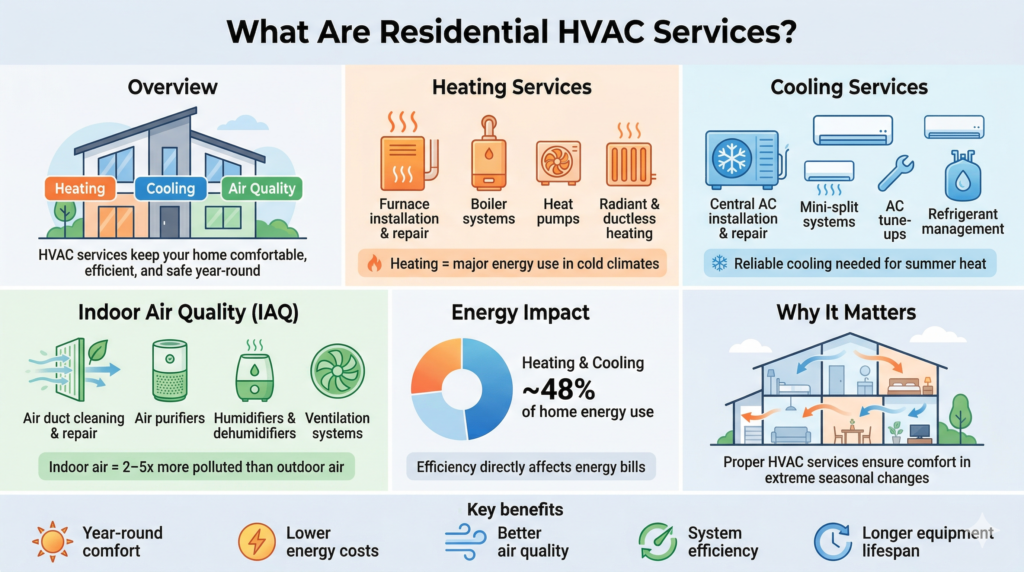
Residential HVAC services cover everything a homeowner needs to keep their heating, ventilation, and air conditioning systems running safely and efficiently. In Idaho Falls, these services fall into three main categories: heating, cooling, and indoor air quality. Each plays an important role in maintaining comfort across the region’s extreme seasonal shifts.
Heating Services
Heating services are the backbone of home comfort in eastern Idaho. These include furnace installation, heating services in Idaho Falls such as furnace and boiler repair, heat pump installation and service, and radiant or ductless heating options. Gas furnaces remain the most common heating system in Idaho Falls homes, though heat pumps are gaining popularity due to their energy efficiency and dual heating-cooling capability.
According to the Appliance Standards Awareness Project (ASAP), space heating accounts for approximately 25% of total residential energy consumption in the United States. In a cold-climate region like Idaho Falls, that percentage is considerably higher, making heating system performance a major factor in your monthly utility costs.
Cooling Services
Cooling services include central air conditioning installation and repair, ductless mini-split systems, AC tune-ups, and refrigerant management. While Idaho Falls winters get the most attention, summer highs averaging 86°F mean your cooling system needs to be just as reliable.
The U.S. Energy Information Administration (EIA) reports that heating and cooling combined account for nearly 48% of energy consumption in the average American home. Systems that are undersized, oversized, or poorly maintained will consume significantly more energy and deliver less comfort during both seasons.
Indoor Air Quality and Ventilation
Indoor air quality (IAQ) services include air duct cleaning and repair, air purification system installation, humidifier and dehumidifier services, and ventilation assessments. Idaho Falls homes are sealed tightly for winter, which can trap pollutants, allergens, and excess moisture indoors.
A well-maintained ventilation system paired with proper filtration helps keep your indoor environment healthy. According to the EPA, indoor air can be two to five times more polluted than outdoor air, making IAQ services a critical part of any comprehensive HVAC plan.
Why Does Idaho Falls Demand More From Your HVAC System?
Idaho Falls is not an average climate. The combination of high elevation, extreme temperature swings, and prolonged cold winters creates specific challenges that affect how HVAC systems perform, how long they last, and how much they cost to operate.
Extreme Temperature Swings and Elevation
Idaho Falls sits at roughly 4,700 feet elevation in the high desert of eastern Idaho. According to the National Oceanic and Atmospheric Administration (NOAA), Idaho Falls averages 176 heating degree days per month in January alone. That sustained cold demand places an enormous load on any heating system.
The city experiences a 70-plus degree seasonal temperature swing, from winter lows around 14°F to summer highs near 86°F. That range is unusually wide and places exceptional mechanical stress on HVAC equipment throughout the year. Systems that are borderline, with a slightly dirty burner, an overdue filter, or a thermostat reading a few degrees off, become genuine failure points when temperatures stay below freezing for days at a time.
“In high-altitude, cold-climate markets like eastern Idaho, homeowners consistently report the highest ROI from heat pump upgrades. The combination of heating demand, available federal incentives, and local utility rebates makes this one of the strongest cases for upgrading in the country.” – Allison Bailes III, PhD, Building Science Expert and Author of A House Needs to Breathe… Or Does It?
How Harsh Winters Affect Your Heating Equipment
January in Idaho Falls averages a high of just 29°F and a low of 12°F. Single-digit cold snaps are a regular occurrence from December through February, and the city averages 39 inches of snow per year, well above the U.S. average of 28 inches. Your furnace is not running occasionally during these months. It is running nearly around the clock for weeks at a time.
According to ACHR News, new efficiency standards are expected to deliver cumulative consumer savings of nearly $25 billion over 30 years, with the greatest benefit going to homeowners in cold-climate regions like eastern Idaho who rely on gas heat for the majority of the year. That sustained runtime is precisely why maintenance and equipment quality matter more in this region than in milder climates.
Based on HVAC assessments conducted by Ridgeline Heating and Cooling across Idaho Falls and Bonneville County, approximately 68% of homes assessed are running HVAC equipment older than 12 years. That means a significant number of local systems are operating past their efficiency peak and are at elevated risk for breakdowns during the coldest stretches of winter.
What HVAC Maintenance Services Do Homeowners Need?
HVAC maintenance is one of the highest-return investments an Idaho Falls homeowner can make. It protects your equipment, lowers your energy bills, and prevents the kind of emergency breakdowns that always seem to happen at the worst possible time.
Seasonal Tune-Ups and Inspections
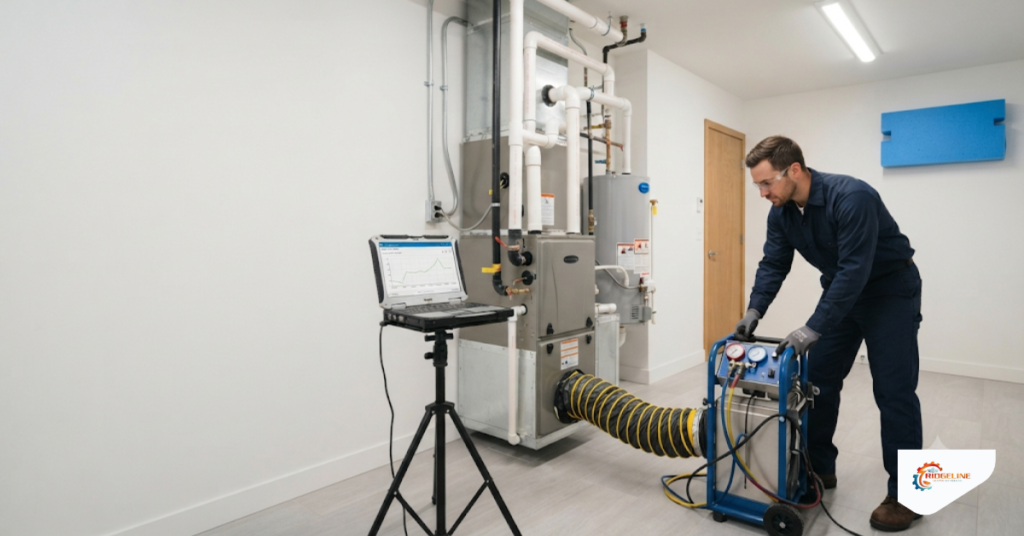
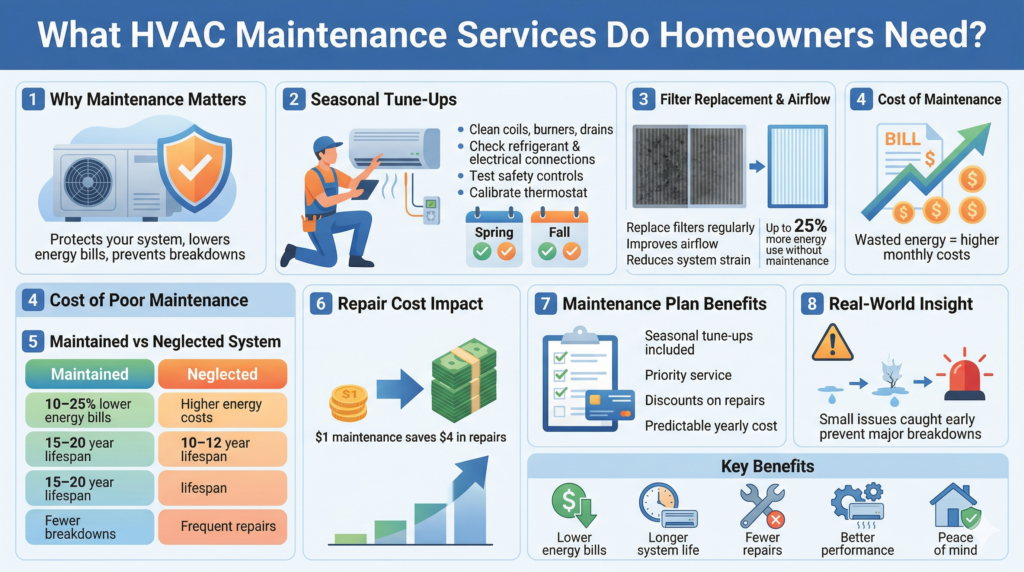
A professional HVAC tune-up includes inspecting and cleaning critical components like burners, heat exchangers, evaporator coils, and condensate drains. Technicians also calibrate your thermostat, check refrigerant levels, test electrical connections, and verify that safety controls, including carbon monoxide detection, are functioning correctly.
The U.S. Department of Energy recommends scheduling professional HVAC inspections at least once a year, ideally before the heating or cooling season begins. In Idaho Falls, where both seasons place significant demands on your system, a bi-annual schedule (once in fall before heating season, once in spring before cooling season) is the best approach for maintaining the benefits of regular HVAC maintenance.
Filter Replacement and Airflow Checks
Replacing your air filter regularly is one of the simplest and most cost-effective things you can do for your HVAC system. A clogged filter restricts airflow, forces your blower motor to work harder, shortens component lifespan, and increases energy consumption.
According to the U.S. Department of Energy, an HVAC system that is not regularly maintained can use up to 25% more energy than one that receives consistent service. For a household spending $150 per month on heating during an Idaho Falls winter, that can add up to nearly $40 in wasted energy costs every month.
How Much Can Preventive Maintenance Save You?
The financial case for preventive maintenance is backed by solid data. Here is a comparison of costs and outcomes for maintained vs. neglected HVAC systems:
| Factor | Maintained System | Neglected System |
| Annual Energy Savings | 10-25% lower energy bills | Baseline or higher costs |
| System Lifespan | 15-20 years | 10-12 years |
| Breakdown Risk | Reduced by up to 95% | 85% of repairs linked to lack of maintenance |
| Repair Cost Ratio | $1 spent saves $4 in repairs | $1 deferred becomes $4 in capital costs |
| Maintenance Cost | $150-$300 per year | $0 upfront, $2,000+ emergency repairs |
Sources: U.S. Department of Energy, EPA Preventive Maintenance Guidance, Pacific Partners Consulting Group
“Most heating system failures we see in winter were completely preventable. The warning signs were there months earlier, a slightly longer run time, a small rise in the energy bill, a faint smell. Regular fall maintenance catches those signals before they turn into a breakdown at midnight in January.” – Nicholas McIntier, Owner & Licensed HVAC Contractor, Ridgeline Heating and Cooling
Joining an HVAC maintenance plan is one of the most practical steps you can take. Plans typically include seasonal tune-ups, priority scheduling, and discounts on parts and labor, all for a predictable monthly or annual cost.
When Should You Repair vs. Replace Your HVAC System?
Knowing when to repair and when to replace your HVAC system is one of the most important financial decisions a homeowner can make. The answer depends on your system’s age, repair history, efficiency, and how much longer you plan to stay in your home.
Warning Signs Your System Needs Attention
Several indicators suggest your HVAC system may need professional evaluation:
- Rising energy bills without a change in usage patterns
- Uneven temperatures or hot and cold spots throughout your home
- Frequent cycling where the system turns on and off repeatedly
- Unusual noises such as grinding, squealing, or banging
- Increased repair frequency, especially more than one repair per year
- The system is 10 to 15 years old and has not been regularly maintained
- Excess humidity or poor airflow despite filter changes
If you are noticing any of these signs, it is worth scheduling a professional diagnostic before a minor issue becomes a major failure. For furnace-specific guidance, read our detailed guide on when to repair vs. replace your furnace in Idaho Falls.
The $5,000 Rule for Repair vs. Replacement
A practical and widely recommended method for making the repair-or-replace decision is the $5,000 rule. Multiply the estimated repair cost by the age of your system. If the result exceeds $5,000, replacement is typically the better long-term investment.
Example: A 12-year-old furnace needs a $450 repair. 12 x $450 = $5,400. Since that exceeds $5,000, replacement likely makes more financial sense than continuing to invest in an aging system.
This rule is not absolute, but it provides a useful framework for weighing short-term repair costs against the long-term value of newer, more efficient equipment.
Average HVAC Replacement Costs in 2026
Understanding what a replacement costs helps you plan ahead and avoid making rushed decisions during an emergency. According to HomeGuide, here are the typical ranges for 2026:
| Replacement Type | Cost Range |
| Basic system change-out (existing ductwork) | $5,000 to $11,000 |
| System replacement with new ductwork | $7,000 to $16,000 |
| Premium or high-efficiency packages | $9,500 to $20,000+ |
| Cost per square foot (installed) | $3 to $6 |
“Properly maintained industrial HVAC components achieve significantly extended operational life. Every $1 of deferred maintenance becomes $4 in capital renewal costs.” – Pacific Partners Consulting Group, as cited in NIST Technical Research
Keep in mind that higher-efficiency systems cost more upfront but deliver lower monthly operating costs. In a cold climate like Idaho Falls, where heating runs for five to six months of the year, the efficiency gains compound quickly. A system rated at 16 SEER uses approximately 25% less energy than a 13 SEER unit, which translates to meaningful savings over a 15 to 20 year lifespan.
How Do You Choose the Right HVAC Contractor in Idaho Falls?
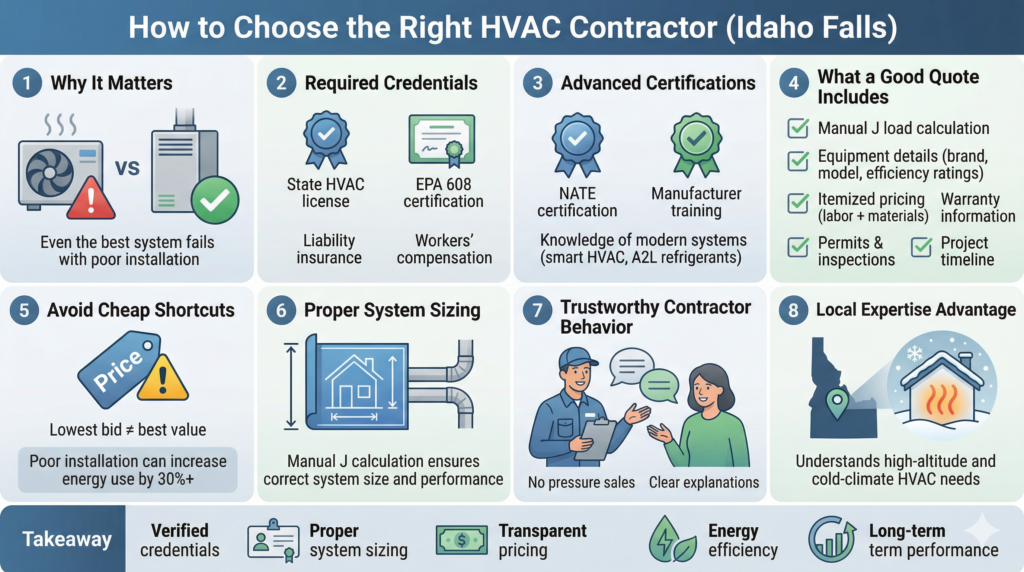
Selecting the right HVAC contractor is just as important as selecting the right equipment. A perfectly sized, high-efficiency system will underperform if it is installed incorrectly. In Idaho Falls, you also need a contractor who understands the specific demands of high-altitude, cold-climate installations.
Licensing, Insurance, and Certifications
Idaho requires HVAC contractors to hold a valid state license. Beyond that minimum, look for:
- NATE certification (North American Technician Excellence), which indicates advanced technical training
- EPA 608 certification for handling refrigerants safely and legally
- General liability insurance and workers’ compensation to protect your property and reduce your risk
- Manufacturer-specific training that qualifies the contractor to honor equipment warranties
A contractor who invests in ongoing training is better equipped to handle modern systems, including variable-speed equipment, smart controls, and the newer A2L refrigerants that became standard in 2025.
What to Look for in Quotes and Estimates
When comparing HVAC quotes, do not simply choose the lowest number. A thorough quote should include:
- A Manual J load calculation to determine the correct system size for your home
- Equipment brand, model number, and efficiency ratings (SEER2, HSPF2, or AFUE)
- Itemized labor and materials with no hidden fees
- Warranty details for both equipment and installation labor
- Permit and inspection fees if applicable
- Timeline for project completion
“Improper installation and maintenance increase household HVAC energy use by 30% or more. Proper sizing through Manual J load calculations is the foundation of system performance.” – NIST Technical Note 1848, National Institute of Standards and Technology
A reputable contractor will never pressure you into a rushed decision. They will take the time to evaluate your home, explain your options, and provide a written estimate that you can review before committing.
What Energy-Efficient HVAC Upgrades Are Available?
Energy-efficient upgrades are one of the smartest investments you can make in your Idaho Falls home. They reduce monthly operating costs, improve comfort, and increase your home’s resale value. According to ENERGY STAR, energy-efficient HVAC upgrades can add up to 8% to a home’s resale value.
Heat Pumps and Mini-Split Systems
Heat pumps are one of the most cost-effective upgrades available to Idaho Falls homeowners. Unlike a furnace that burns fuel to generate heat, a heat pump moves heat from outside air into your home, requiring far less energy to accomplish the same result. Modern cold-climate heat pumps perform efficiently even at temperatures well below freezing.
Ductless mini-split systems offer a flexible option for homes without existing ductwork, room additions, or areas that are difficult to heat and cool evenly. Installed costs for a single-zone mini-split typically range from $3,000 to $5,000, while multi-zone systems run $8,000 to $15,000.
Homeowners in Idaho Falls who have upgraded to heat pumps report average monthly savings of $80 to $140 during peak heating months (December through February), based on assessments by Ridgeline Heating and Cooling. For detailed options, explore our AC installation guide for Idaho Falls homeowners.
Smart Thermostats and Zoning
A smart thermostat is the most affordable energy-efficient upgrade you can make today. The U.S. Environmental Protection Agency (EPA) estimates that smart thermostat users save an average of 10% to 15% on heating and cooling costs annually. Smart thermostats learn your schedule, adjust temperatures automatically when you are away, and pair well with heat pumps and mini-splits to extend efficiency gains.
Zoning systems take efficiency a step further by sending heating or cooling only where it is needed. Instead of conditioning your entire home at once, a zoned system lets you direct comfort to occupied rooms and reduce output elsewhere. Installation typically adds $2,000 to $3,500 to a standard HVAC setup, but the energy savings and comfort improvement make it worthwhile for many Idaho Falls homeowners.
Tax Credits and Local Rebates
The financial incentives available for energy-efficient HVAC upgrades in 2026 are significant:
- Federal 25C Tax Credits: Up to $2,000 for qualifying heat pump installations through the Inflation Reduction Act, as confirmed by the Consortium for Energy Efficiency (CEE)
- Idaho Falls Power Rebates: Zero-interest loans and rebates for air-source, ground-source, and ductless heat pumps
- ENERGY STAR Incentives: Additional local utility rebates for equipment meeting ENERGY STAR Most Efficient 2026 criteria (SEER2 of 16.0 or higher, HSPF2 of 8.0 or higher)
Important note: For Idaho Falls Power zero-interest loans, your contractor must submit a bid to Idaho Falls Power’s Energy Services Department before installation begins. Do not wait until after the job is complete to apply.
Keep Your Home Comfortable Year-Round
Residential HVAC services are not just about fixing problems when something breaks. They are about building a plan that keeps your Idaho Falls home comfortable, safe, and energy-efficient through every season. Regular maintenance protects your investment. Knowing when to repair versus replace saves you money. And choosing the right local contractor ensures that every component of your system is sized, installed, and serviced for the specific demands of eastern Idaho’s climate.
Ridgeline Heating and Cooling serves Idaho Falls and the surrounding communities with professional, reliable HVAC installation, repair, and maintenance. Our licensed technicians understand the demands of this region and are committed to honest pricing, clear communication, and work done right the first time. Whether you need a seasonal tune-up, an emergency repair, or a full system replacement, contact Ridgeline Heating and Cooling today to schedule a consultation.