



Aeroseal duct sealing is an advanced technology that seals leaks inside your ductwork from the inside out using a non-toxic aerosol polymer sealant. It closes up to 95% of duct leaks in a single visit, helping Idaho Falls homeowners reduce heating and cooling energy waste by 20 to 30 percent.
Key Takeaways
- Leaky ducts waste 20-30% of all heated or cooled air your system produces
- Aeroseal seals from the inside out using a safe, non-toxic aerosol sealant that automatically finds every leak
- Most homeowners see 15-30% reductions in monthly energy bills after treatment
- The process takes one day and delivers a verified before/after performance report in cubic feet per minute
- Idaho Falls winters make duct efficiency especially critical for furnace and heat pump performance
What Is Aeroseal Duct Sealing?
Aeroseal is a patented duct sealing technology originally developed at the Lawrence Berkeley National Laboratory. Unlike traditional sealing methods that work from the outside of your ductwork using mastic paste or metal tape on accessible joints, Aeroseal works entirely from inside the HVAC system. A non-toxic, water-based polymer sealant is aerosolized and injected directly into your ducts, where air pressure carries it to every leak, crack, and gap throughout the system.
The sealant particles accumulate along the edges of each opening and gradually build up a permanent, airtight seal. The same base material is found in everyday products like baby pacifiers and chewing gum, making it safe for your family and pets. As of 2025, Aeroseal has sealed more than 300,000 homes and over 500 million square feet of commercial space across more than 90 countries.
The Expert Behind the Technology
Aeroseal was invented by Dr. Mark Modera, a researcher at Lawrence Berkeley National Laboratory, with funding from the U.S. Department of Energy. Dr. Modera has described the core problem that inspired the technology:
“Duct leakage is one of the most significant and underappreciated sources of energy waste in American homes. The ability to seal those leaks from the inside, without tearing open walls or ceilings, was the breakthrough that made widespread adoption practical.”
— Dr. Mark Modera, inventor of Aeroseal technology, Lawrence Berkeley National Laboratory / UC Davis Western Cooling Efficiency Center
What Makes It Different from Traditional Duct Sealing Methods
Traditional duct sealing requires a technician to physically apply mastic compound or metallic tape to duct joints they can see and reach. This approach works for accessible sections of ductwork but misses the hidden leaks deep inside wall cavities, attic spaces, and long duct runs that are often the worst offenders. Aeroseal reaches every leak in the entire system, regardless of where it is located.
| Method | Reaches Hidden Leaks | Verified Results |
| Mastic / Tape | No | No |
| Aeroseal | Yes | Yes – Printed Report |
The printed performance report Aeroseal provides is a major advantage over traditional approaches. You see the before and after leakage numbers in cubic feet per minute, giving you verifiable documentation of the results.
Why Leaky Ducts Are Costing Idaho Falls Homeowners More Than They Realize
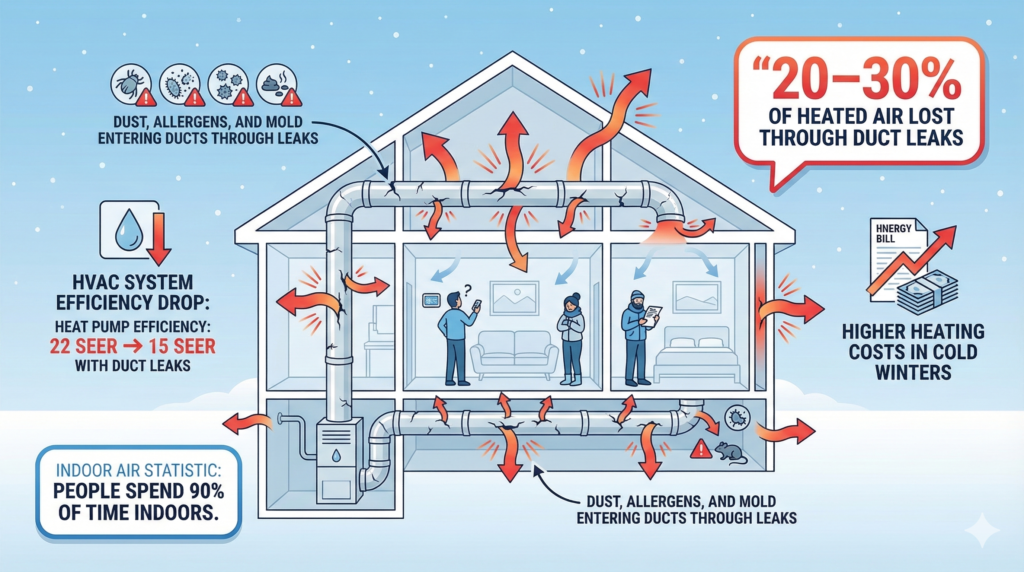
Most Idaho Falls homeowners never think about their ductwork until something goes wrong. But according to the U.S. Department of Energy, the average home loses 20 to 30 percent of the air moving through its duct system to leaks, holes, and poorly connected joints. In Idaho Falls, where furnaces and heat pumps work hard through long, cold winters, that energy loss adds up to hundreds of dollars every single season.
The Hidden Energy Loss Problem
Duct leaks are typically hidden inside walls, ceilings, and crawl spaces. You cannot see them, but you feel their effects: uneven temperatures, rooms that are hard to heat, and energy bills that keep climbing. According to research from Lawrence Berkeley National Laboratory, duct system energy losses account for up to 25% of all heating and cooling energy in a typical home.
The impact on high-efficiency HVAC equipment is especially significant. Aeroseal’s 2024 Air Sealing Guide documents that a 20% duct leakage rate can drop a heat pump’s SEER efficiency rating from 22 to just 15. That is a 32% efficiency reduction, meaning a premium system performs like a mid-grade unit simply because the ducts are leaking.
Ridgeline field data: Based on duct leakage assessments performed by Ridgeline Heating and Cooling technicians across Idaho Falls homes, the majority of properties built before 2000 tested at leakage rates above 25% of total system airflow. Homes in the 2000-2010 build range averaged 15-20% leakage. In nearly every case, post-Aeroseal testing confirmed leakage reduced to below 5%, bringing systems into alignment with current ASHRAE performance standards.
Dr. Neil Leslie, former Technical Director at the Gas Research Institute and a widely cited expert in building energy efficiency, has stated in industry publications:
“You can install the most efficient HVAC equipment available, but if your duct system is leaking, you are throwing money out of your walls every time the system runs.”
— Dr. Neil Leslie, former Technical Director, Gas Research Institute
How Duct Leaks Affect Indoor Air Quality
Leaky ducts do not just waste energy. They create direct pathways for dust, allergens, mold spores, and outdoor pollutants to enter your air supply. According to the U.S. Environmental Protection Agency, Americans spend approximately 90% of their time indoors, where concentrations of some pollutants can be two to five times higher than outdoor levels.
Understand Aeroseal Duct Sealing For Better HVAC Efficiency
When your ducts pull in air from crawl spaces, attics, or wall cavities through leaks, that air bypasses your filter entirely. Homeowners with significant duct leakage often notice increased dust buildup, worsening allergy symptoms, and humidity imbalances. Sealing your ducts addresses the root cause. For a complete approach to indoor air health, review our guide on air duct cleaning benefits for Idaho Falls homes.
What Happens During an Aeroseal Treatment? (Step-by-Step)
Aeroseal duct sealing is a one-day process that requires no demolition, no cutting into walls, and no major disruption to your daily life. Here is exactly what a certified technician does during treatment.
Step 1: Preparation and Baseline Leak Testing
- The technician blocks all supply and return vents with foam covers, isolating the duct system for accurate pressure testing.
- A computer-controlled Aeroseal machine connects to the system and records your current leakage rate in cubic feet per minute (CFM). This is your documented starting point.
- The technician reviews the baseline with you so you understand exactly how much air your ducts are currently losing before any sealing begins.
Step 2: Sealant Injection and Real-Time Monitoring
- The machine pressurizes the duct system and releases a fine aerosol mist of the polymer sealant into the ducts.
- Air pressure carries the particles to every opening, gap, and crack throughout the entire system, including areas hidden deep in walls and ceilings.
- Particles collect along the edges of each leak, gradually building up a permanent seal. The technician monitors the leakage reduction in real time on a laptop screen.
- The machine shuts off automatically when the target reduction, often up to 95% of total leakage, has been achieved.
Step 3: Verification and Performance Report
After sealing is complete, a second pressure test confirms the results. You receive a printed before/after performance report showing your exact leakage reduction in CFM. This verified documentation is something traditional mastic-and-tape methods simply cannot provide. Total treatment time for a standard Idaho Falls home is typically four to eight hours.
What Are the Real Benefits of Aeroseal for Your Home?
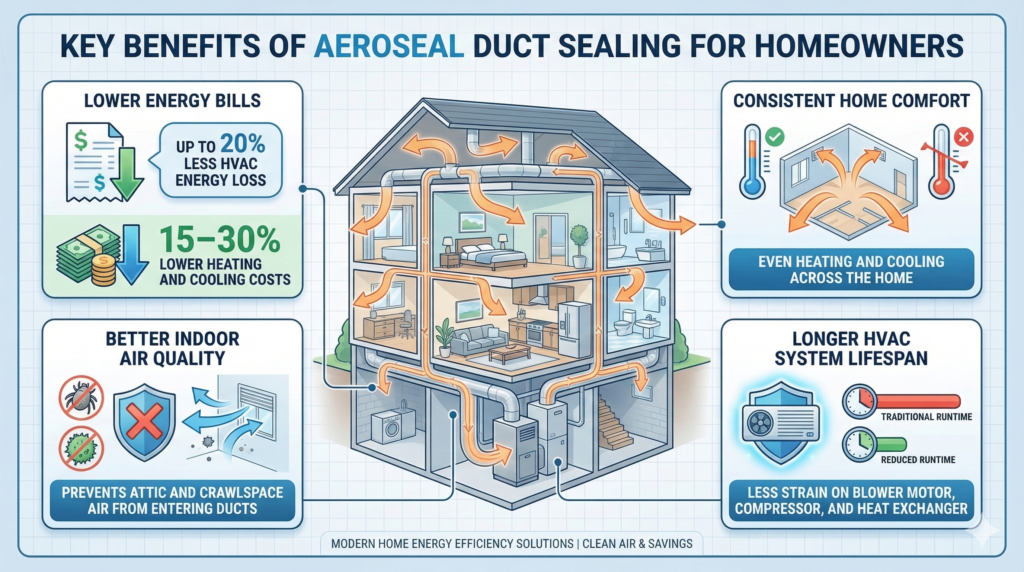
Aeroseal duct sealing delivers four primary, measurable benefits: lower energy bills, more consistent comfort, better indoor air quality, and a longer-lasting HVAC system. Each benefit stands on its own and is backed by verifiable data.
Lower Energy Bills and More Consistent Comfort
By eliminating conditioned air escaping through leaks, your HVAC system no longer has to overwork to compensate for the loss. According to ENERGY STAR, properly sealed ductwork can reduce HVAC energy losses by up to 20%, and most homeowners report overall bill reductions of 15 to 30% after treatment. For a typical Idaho Falls home spending $200 per month on heating and cooling, that translates to annual savings of $360 to $720.
Beyond the bills, sealed ducts produce balanced airflow throughout your home. Rooms that were previously too hot in summer or too cold in winter receive their proper share of conditioned air. This is especially impactful in larger homes with multiple stories or long duct runs. Pairing Aeroseal with consistent regular HVAC maintenance ensures your system sustains peak efficiency year-round.
Better Indoor Air Quality
Sealed ducts prevent unconditioned air from being drawn into your living spaces from crawl spaces, attics, and wall cavities. This keeps dust, allergens, and carbon monoxide backdraft risks out of your air supply. Families with members who have allergies, asthma, or respiratory sensitivities often notice a meaningful improvement in the weeks following treatment.
Changing your air filter on a proper schedule works hand-in-hand with sealed ductwork. Our guide on how often to change your air filter covers recommended intervals for Idaho Falls homes.
Extended HVAC System Lifespan
When your ducts leak, your furnace, heat pump, or air conditioner runs in longer cycles to compensate for the air loss. That extended runtime creates wear and tear on critical components including the blower motor, heat exchanger, and compressor. Aeroseal reduces the runtime your system needs to maintain set temperatures, which directly extends its service life and lowers the likelihood of premature repairs or early replacement.
Is Aeroseal Duct Sealing Worth the Cost?
For most Idaho Falls homeowners with moderate to significant duct leakage, Aeroseal is a cost-effective investment with a clear and achievable payback period.
Typical Pricing for Idaho Falls Homes
Aeroseal treatment for a typical residential home ranges from $1,300 to $3,000, depending on the size of the home, the accessibility of the duct network, and the severity of existing leakage. Larger homes with complex duct systems sit at the higher end of that range. This is a one-time investment. Aeroseal’s polymer sealant is engineered to last the full lifetime of your ductwork with no re-treatment required.
How Long Before It Pays for Itself?
A home saving $500 per year after an Aeroseal treatment at $1,800 sees a full payback in under four years. Homes with severe leakage, higher energy costs, or those preparing to invest in new high-efficiency HVAC equipment often see faster returns. One HVAC professional noted that after Aeroseal treatment allowed a homeowner to downsize their replacement unit from 4 tons to 2 tons, the equipment savings alone covered the cost of sealing. You may also be eligible for federal energy efficiency tax credits. Review our HVAC tax credits guide to see what applies to your home.
For additional year-round savings strategies that work alongside sealed ductwork, see our tips on how to lower your heating bill this winter.
How Do You Know If Your Home Needs Aeroseal?
Not every home requires Aeroseal, but certain signs strongly indicate significant duct leakage worth addressing. Use the table below to identify whether your home shows common warning patterns.
| Warning Sign | What It Suggests |
| Rooms that never reach set temperature | Conditioned air escaping before reaching those rooms |
| Unexplained rise in energy bills | HVAC working harder to compensate for air loss |
| Excessive dust shortly after cleaning | Outside air pulled in through duct leaks |
| HVAC running in very long cycles | System cannot hit target temperature efficiently |
| New HVAC system still underperforming | Equipment efficiency negated by duct leakage |
If two or more of these apply to your home, a professional duct leakage assessment is a worthwhile first step. A certified technician from Ridgeline Heating and Cooling can pressure-test your system and give you an accurate picture of what is happening in your ductwork before recommending any treatment.
Gary McCreadie, host of the HVAC Know It All Podcast and a widely respected industry educator, discussed duct sealing in a two-part episode with Aeroseal inventor Dr. Modera:
“Most contractors and homeowners are shocked when they see the baseline leakage numbers. Duct leaks are invisible, so people simply do not realize how much conditioned air they are losing until they measure it. That measurement is where the conversation has to start.”
— Gary McCreadie, HVAC educator and host, HVAC Know It All Podcast
What Idaho Falls Homeowners Are Saying
“We had been fighting uneven temperatures in our home for years. Two bedrooms upstairs were always freezing in winter no matter what we did. After Ridgeline came out and did the Aeroseal treatment, the difference was noticeable within the first week. Our heating bill dropped by about $90 the first month. I wish we had done it years ago.”
— Verified customer, Idaho Falls, ID. Aeroseal treatment completed Winter 2025.
“I was skeptical about spending $1,500 on something I couldn’t see, but the before and after report made it concrete. We went from 38% duct leakage down to 4%. Our HVAC runs noticeably less and the house holds temperature much more evenly now.”
— Verified customer, Rexburg, ID. Aeroseal treatment completed Fall 2024.
Ready to Stop Paying for Air That Never Reaches Your Rooms?
Leaky ductwork quietly wastes hundreds of dollars every year, money you are paying to heat or cool air that escapes before it reaches a single room in your home. Aeroseal duct sealing addresses that problem permanently, with verified results you can hold in your hands.
If you have been noticing uneven temperatures, rising energy bills, or air quality concerns in your Idaho Falls home, Aeroseal could be the most cost-effective improvement you make this year. Our certified technicians serve Idaho Falls and the surrounding communities, including Rexburg, Blackfoot, Rigby, and Shelley.
Contact Ridgeline Heating and Cooling today to schedule a duct leakage assessment. We will give you an honest picture of your home’s duct performance and clear, upfront options before any work begins. Your comfort, your air quality, and your energy bills all benefit when your ductwork finally does its job.