 Skip to content



Yes, tankless water heaters are worth it for most Idaho Falls homeowners. They are 24-34% more energy-efficient than traditional tank models, last 15-20 years or longer, and deliver unlimited hot water on demand. Idaho’s moderate groundwater temperatures make gas tankless units a strong performer here, and federal tax credits can help offset the higher upfront cost.
Are Tankless Water Heater Worth It?
That said, tankless systems are not the right fit for every home. The answer depends on your household size, hot water usage patterns, fuel type, and budget. This guide breaks down the real costs, benefits, and trade-offs so you can make a confident decision for your Idaho Falls home.
Key Takeaways
- Tankless water heaters save energy and money long-term. The U.S. Department of Energy reports they use 24-34% less energy than conventional tank heaters for homes using 41 gallons or less per day.
- Idaho’s groundwater temperature (46-55 degrees F) supports strong tankless performance. Gas models can deliver 5 gallons per minute even with cold inlet water.
- Installation costs range from $1,400 to $5,600, but the 15-20+ year lifespan and lower operating costs close the gap over time.
- Gas tankless units are the best whole-house option for Idaho Falls. Electric models work well for single-fixture applications.
- Federal tax credits up to $600 may apply for qualifying ENERGY STAR certified gas tankless installations through 2032.
How Does a Tankless Water Heater Work?
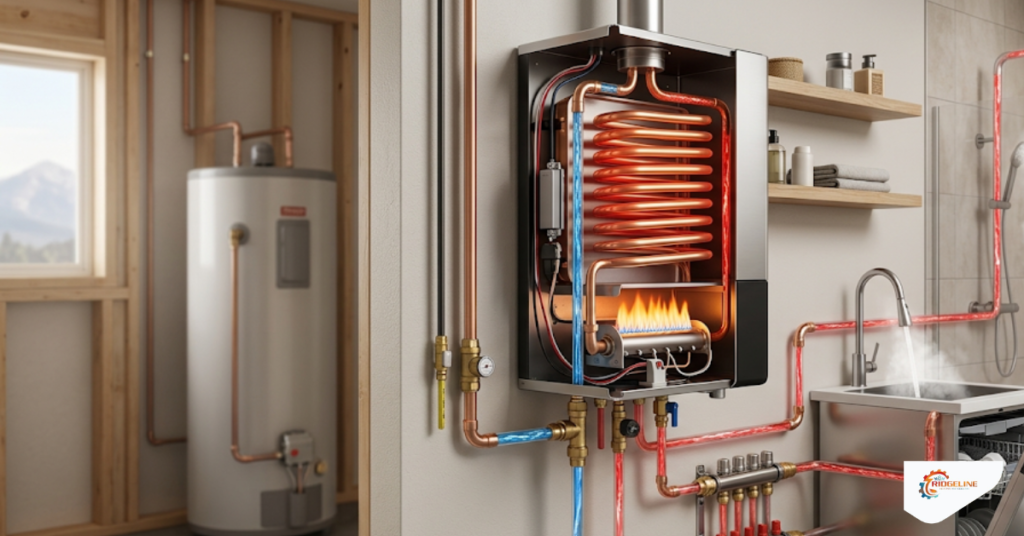
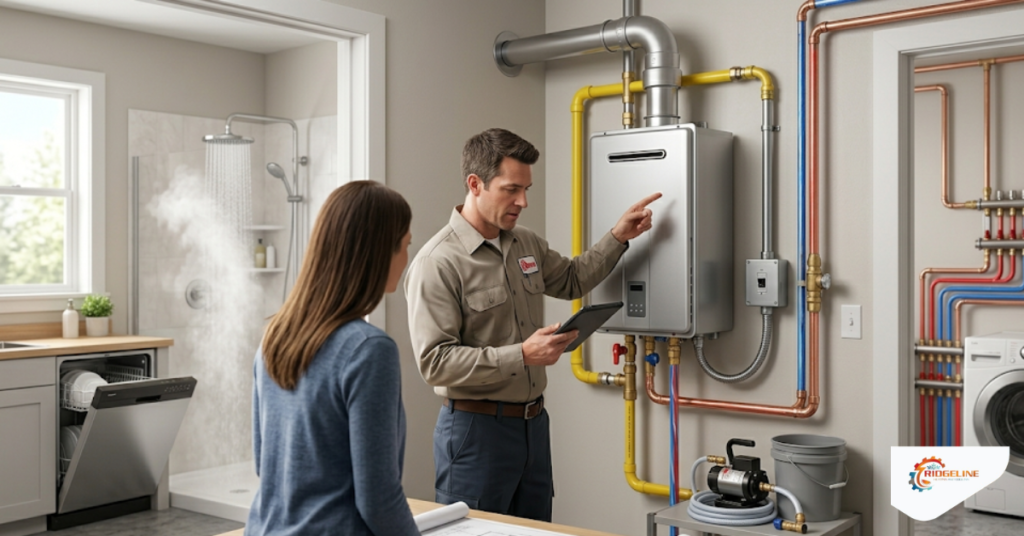
A tankless water heater heats water the moment you turn on a faucet, shower, or appliance. Instead of storing and continuously reheating 40-80 gallons in a tank, it uses a powerful gas burner or electric element to bring cold water up to temperature as it flows through a heat exchanger. The unit only uses energy when hot water is actively flowing.
On-Demand Heating vs. Tank Storage
Traditional tank water heaters maintain a reservoir of hot water around the clock, even when nobody is using it. This constant reheating is called standby heat loss, and it accounts for a significant portion of your water heating energy costs. Tankless systems eliminate standby loss entirely because they only fire up when you open a hot water tap.
For Idaho Falls homeowners comparing fuel options, our guide on propane vs natural gas covers which fuel type works best for different home setups.
Gas vs. Electric Tankless Units
Gas tankless water heaters deliver higher flow rates, typically 2-5 gallons per minute for residential models, making them the better choice for whole-house applications. Electric tankless units are more affordable and easier to install, but their lower flow capacity (often 2-3 GPM) limits them to single-point uses like a bathroom sink or a small apartment.
In colder climates like Idaho Falls, gas models have a clear performance advantage. They can maintain adequate hot water output even when the incoming water temperature drops, which is a critical factor we will cover below.
What Are the Benefits of Going Tankless in Idaho Falls?
Switching to a tankless water heater brings several practical advantages for Idaho Falls homeowners, from lower monthly bills to decades of reliable service.
Energy Savings and Lower Utility Bills
According to the U.S. Department of Energy, tankless water heaters are 24-34% more energy-efficient for homes that use 41 gallons of hot water or less per day. Even high-usage households (86+ gallons daily) see 8-14% energy savings. In dollar terms, operating a tankless unit typically costs $220-$540 per year, compared to $250-$600 for a conventional tank.
Those savings add up quickly over the life of the unit, especially as energy prices continue to rise in Southeast Idaho.
Longer Lifespan and Less Maintenance
A traditional tank water heater typically lasts 8-12 years before it needs full replacement. Tankless units routinely last 15-20 years, and many push past 20 years with proper care. Their modular design means individual components can be replaced without scrapping the entire system.
The main maintenance requirement is annual flushing to remove mineral scale buildup. For more on why this matters, see our post on the importance of flushing your water heater.
Unlimited Hot Water and Space Savings
Because tankless systems heat water continuously as it flows through, you never run out of hot water mid-shower or while running the dishwasher. This is a major upgrade for larger families or homes where multiple people need hot water at the same time.
Tankless units are also significantly smaller than 40-80 gallon tanks. Most wall-mounted models are about the size of a small suitcase, freeing up valuable floor space in your basement, utility closet, or garage.
Do Tankless Water Heaters Work Well in Idaho’s Cold Climate?
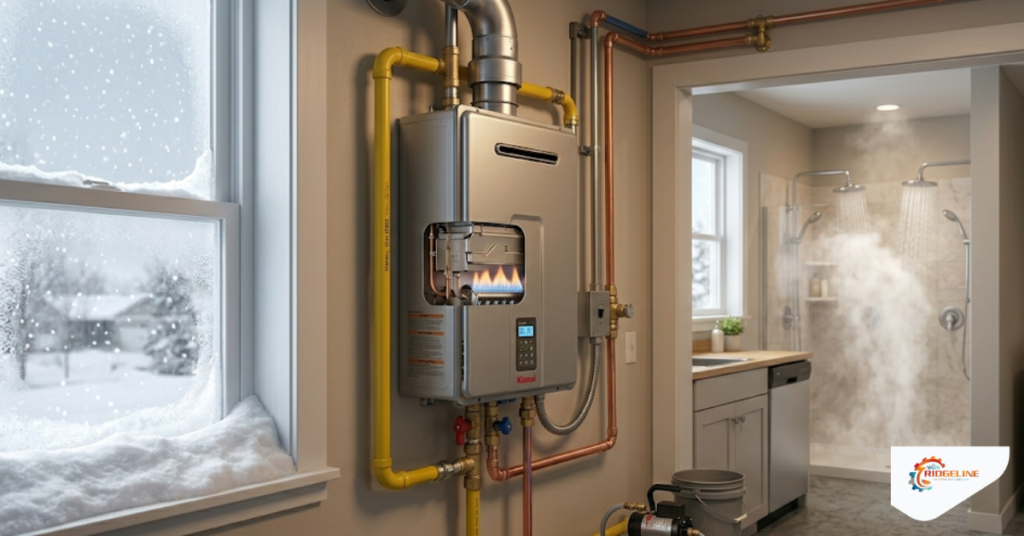
This is the most common concern Idaho Falls homeowners raise, and the short answer is yes. Gas tankless water heaters perform reliably in cold climates when properly sized.
How Groundwater Temperature Affects Flow Rate
The colder the incoming water, the harder a tankless unit has to work to raise it to your desired temperature (usually 120 degrees F). This relationship is called “temperature rise.” According to HydroFLOW’s Idaho data, Idaho’s average groundwater temperature ranges from 46-55 degrees F. That means a tankless unit in Idaho Falls needs to raise the water temperature by roughly 65-74 degrees, which reduces the effective flow rate compared to warmer climates.
For a unit rated at 8 GPM, you can expect roughly 4.5-5.5 GPM of actual output in Idaho conditions. That is still enough for most households to run two to three fixtures simultaneously.
Why Gas Tankless Units Outperform Electric in Cold Regions
The American Society of Plumbing Engineers confirms that gas tankless models perform well with groundwater temperatures as low as 40 degrees F. Over 100,000 gas tankless water heaters are sold in Canada each year, where groundwater can dip to 38 degrees F.
According to Rinnai’s cold climate testing, their gas tankless units deliver 5 gallons per minute with 40-degree groundwater. That is enough to run three showers at the same time. Electric tankless models, by contrast, struggle with the high temperature rise required in cold regions and are better suited for single-point applications in Idaho.
How Much Does Tankless Water Heater Installation Cost?
The higher upfront cost is the biggest hesitation for most homeowners. Here is what you can realistically expect to pay in 2026.
Upfront Cost Breakdown
According to Angi, tankless water heater installation costs between $1,405 and $3,899 for most homes, with $2,637 being the national average. Gas models cost more than electric due to venting and gas line requirements.
| Cost Factor | Typical Range |
| Gas tankless unit + installation | $2,100 – $5,600 |
| Electric tankless unit + installation | $1,400 – $3,000 |
| Gas line upgrade (if needed) | $200 – $800 |
| Venting installation | $200 – $600 |
| Permits and old unit removal | $200 – $500 |
Older Idaho Falls homes that require gas line upgrades or new venting will land on the higher end. Homes with existing gas infrastructure will pay significantly less.
Federal Tax Credits and Incentives
Gas tankless water heaters with a Uniform Energy Factor (UEF) of 0.95 or higher and ENERGY STAR certification can qualify for a federal tax credit of up to $600 under the Energy Efficient Home Improvement Credit. This program runs through 2032, though starting in 2026, a Product Identification Number (PIN) from the manufacturer is required when filing.
The $600 credit falls under the $1,200 annual cap for traditional efficiency improvements, separate from the $2,000 cap for heat pump systems. You can stack this with other qualifying upgrades like insulation or efficient windows in the same tax year.
What Are the Downsides of Tankless Water Heaters?
No system is perfect. Here are the trade-offs to consider before making the switch.
Higher upfront cost. Even with tax credits, a tankless installation costs two to three times more than a standard tank replacement. The long-term energy savings and extended lifespan help close that gap, but the initial investment is real.
Flow rate limitations during simultaneous use. A single tankless unit may struggle if you run the shower, dishwasher, and washing machine all at once. Proper sizing is critical. Some larger homes benefit from installing two units or pairing a whole-house gas unit with a point-of-use electric heater for high-demand fixtures.
Annual flushing is required. Mineral scale builds up inside the heat exchanger over time, especially in areas with harder water. Annual flushing costs $100-$200 and is essential to maintain efficiency and prevent damage. Our guide on whether water heaters need to be flushed every year explains the process in detail.
Installation complexity. Switching from a tank to tankless often requires gas line upgrades, new venting, and electrical work. This adds to the cost and timeline, especially in older homes.
Should Idaho Falls Homeowners Make the Switch?
For most Idaho Falls homeowners, a gas tankless water heater is a smart long-term investment. The combination of 24-34% energy savings, a 15-20+ year lifespan, unlimited hot water, and available tax credits makes the math work out favorably over time, even with the higher upfront cost.
A tankless system makes the most sense if your current tank water heater is approaching the end of its life (check the signs in our guide on when to replace your hot water heater), if you are tired of running out of hot water, or if you want to reduce your monthly energy bills.
The key is proper sizing. An undersized unit will leave you frustrated, while a correctly matched system delivers reliable comfort year-round, even through Idaho’s coldest months.
If you are considering a tankless water heater for your home, the Ridgeline Heating and Cooling team can help you choose the right unit, handle the full installation, and make sure the system is sized for your household’s needs. Contact Ridgeline Heating and Cooling for a free consultation and honest estimate.


