Skip to content



Tank water heaters cost less upfront and work well for most households, while tankless models deliver better energy efficiency and unlimited hot water at a higher initial price. The right choice depends on your budget, household size, and how much hot water your family uses daily. Here is what Idaho Falls homeowners should know before deciding.
Key Takeaways
- Tank water heaters cost $500 to $2,000 for the unit, with lower installation costs, but have higher monthly energy bills and shorter lifespans of 10 to 15 years
- Tankless water heaters cost $1,000 to $3,000 upfront but are 24% to 34% more energy efficient and can last 20 or more years
- Your household size, daily hot water usage, and long-term budget goals determine the best fit
- Gas tankless units perform well in Idaho Falls, even with cold groundwater temperatures as low as 40°F
How Do Tankless vs Tank Water Heaters Work?
Understanding how each system operates helps you match your water heater to your household needs. Both use gas or electricity to heat water, but they deliver hot water in very different ways.
Traditional Tank Water Heaters
Tank water heaters store 30 to 80 gallons of hot water in an insulated tank. Cold water enters through a dip tube at the bottom, where gas burners or electric heating elements warm it. The heated water rises to the top, ready for use whenever you turn on a faucet. When you draw hot water, the tank refills and reheats automatically.
The tradeoff? Once you empty the tank during back-to-back showers or laundry loads, you will wait 30 minutes to an hour for the water to reheat. Tank systems also lose heat while water sits idle, which accounts for roughly 10% to 15% of your water heating costs.
On-Demand Tankless Water Heaters
Tankless water heaters skip the storage step entirely. When you turn on the hot water tap, a flow sensor activates a heat exchanger that rapidly heats water as it passes through. Gas burners or electric coils bring cold water up to temperature in seconds, delivering 2 to 5 gallons of hot water per minute.
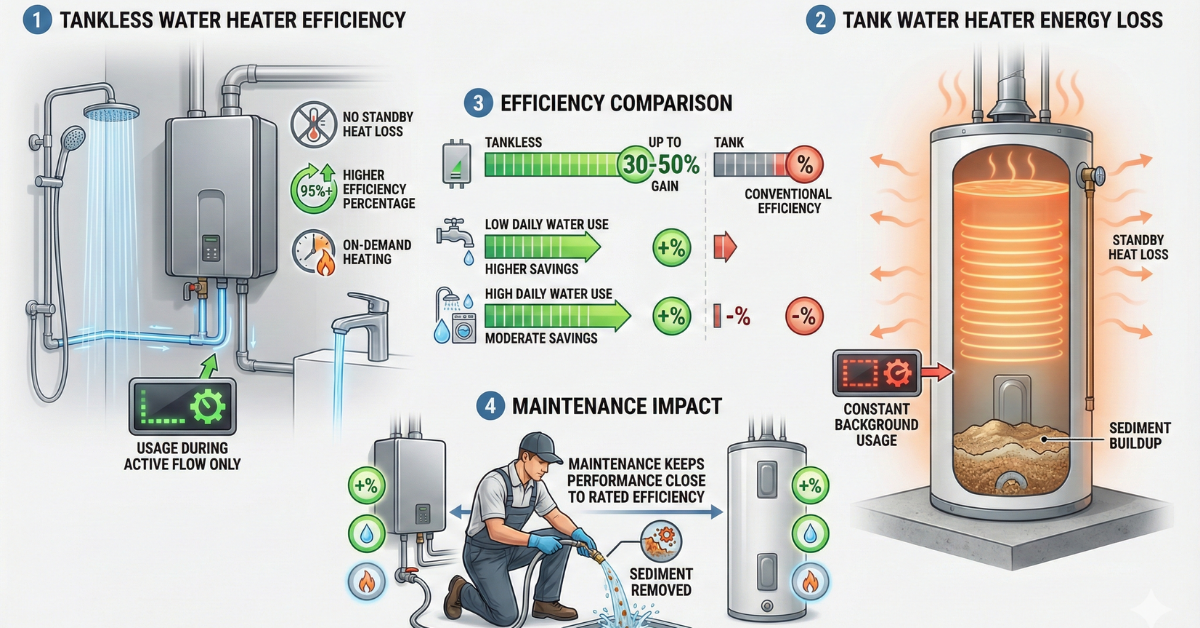
Because tankless systems heat water only when needed, there is no standby heat loss. This design makes them significantly more efficient, though they can struggle if multiple fixtures demand hot water simultaneously.
Need this handled in Idaho Falls? See our water heater repair and replacement page or call (208) 521-2041.
What Are the Pros and Cons of Each System?
Every water heater type has strengths and limitations. Weighing the tankless water heater pros and cons against traditional tank systems will help you make a confident decision.
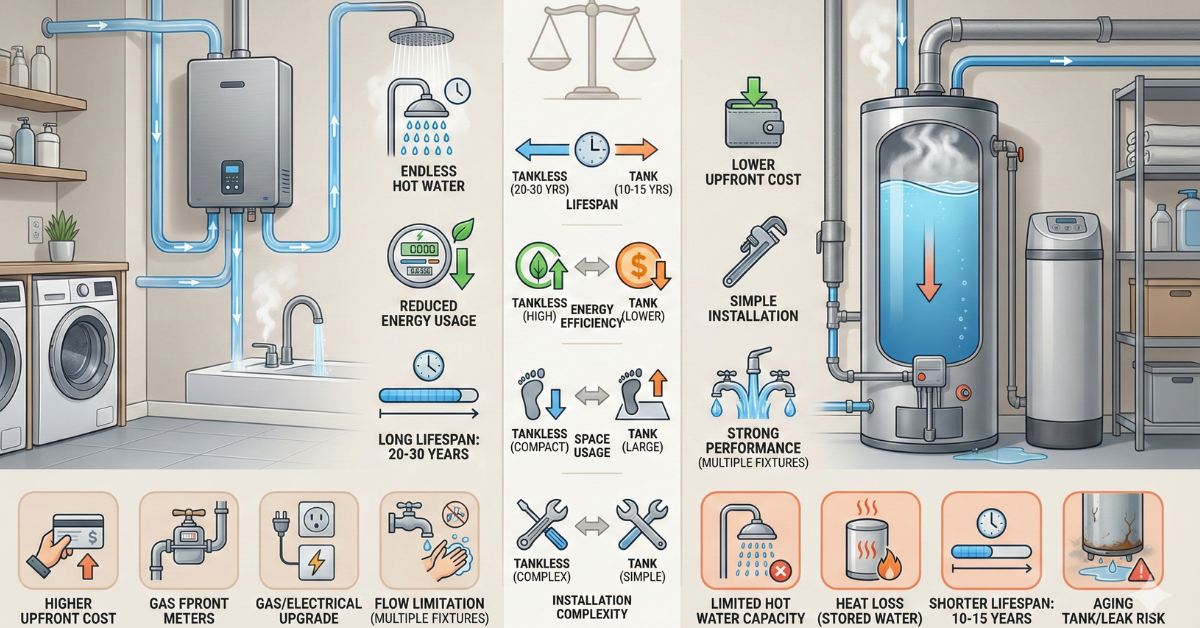
Tankless Water Heater Pros and Cons
Advantages:
- Unlimited hot water on demand, so you never run out mid-shower
- Energy savings of 24% to 34% for homes using 41 gallons or less daily, according to the U.S. Department of Energy
- Compact, wall-mounted design that frees up floor space
- Lifespan of 20 to 30 years with proper maintenance
Disadvantages:
- Higher upfront cost for the unit and installation
- May require gas line upgrades or electrical panel modifications
- Flow rate limitations when multiple fixtures run simultaneously
Tank Water Heater Pros and Cons
Advantages:
- Lower purchase price and simpler installation
- Works with existing plumbing without major modifications
- Reliable performance for high simultaneous hot water demand
Disadvantages:
- Limited hot water supply based on tank capacity
- Standby heat loss increases energy bills
- Shorter lifespan of 10 to 15 years, with potential for leaks as the tank ages
How Do Upfront and Long-Term Costs Compare?
The cost difference between tankless and tank water heaters extends beyond the sticker price. Installation, energy bills, and replacement frequency all factor into the total investment over time.
| Factor | Tank Water Heater | Tankless Water Heater |
| Unit Cost | $500 to $2,000 | $1,000 to $3,000 |
| Installation Cost | $500 to $1,000 | $1,500 to $3,000 |
| Energy Efficiency | 40% to 60% | 80% to 99% |
| Annual Energy Savings | Baseline | $100 to $170 per year |
| Lifespan | 10 to 15 years | 20 to 30 years |
| Hot Water Supply | Limited by tank size | Unlimited on-demand |
| Space Required | Large floor footprint | Wall-mounted, compact |
According to the American Council for an Energy-Efficient Economy, water heating accounts for about 13% of annual residential energy use. New efficiency standards taking effect in 2029 will save households approximately $170 per year on utility bills.
Which System Is More Energy Efficient?
Tankless water heaters win the efficiency contest. Testing by Consumer Reports found gas tankless models were 22% more energy efficient than gas-fired tank water heaters on average.
The U.S. Department of Energy reports that tankless systems can be 24% to 34% more efficient for homes using 41 gallons or less of hot water daily. Even high-usage homes see 8% to 14% efficiency gains. These savings come from eliminating standby heat loss, since tankless units only consume energy when hot water is actively flowing.
If you notice rust in your water or sediment buildup, your current water heater may be losing efficiency. Regular maintenance, including annual water heater flushing, helps both tank and tankless systems perform at their best.
Does a Tankless Water Heater Work in Idaho’s Cold Climate?
Yes, and this is good news for Idaho Falls homeowners. A common misconception is that tankless water heaters struggle in cold regions, but gas tankless units perform reliably even when groundwater temperatures drop.
According to ASPE Pipeline, most gas tankless models handle groundwater temperatures as low as 40°F without performance issues. Over 100,000 gas tankless water heaters are sold in Canada each year, where groundwater can dip to 38°F. If these systems work in Canadian winters, they can certainly handle Idaho’s climate.
The key is proper sizing. A licensed technician will calculate the temperature rise needed based on your incoming groundwater temperature and desired hot water output. For most residential uses, a setting of 120°F to 125°F provides comfortable hot water while protecting against scalding. Gas models generally outperform electric tankless units in cold climates because they heat water faster.
How Much Hot Water Does Your Household Need?
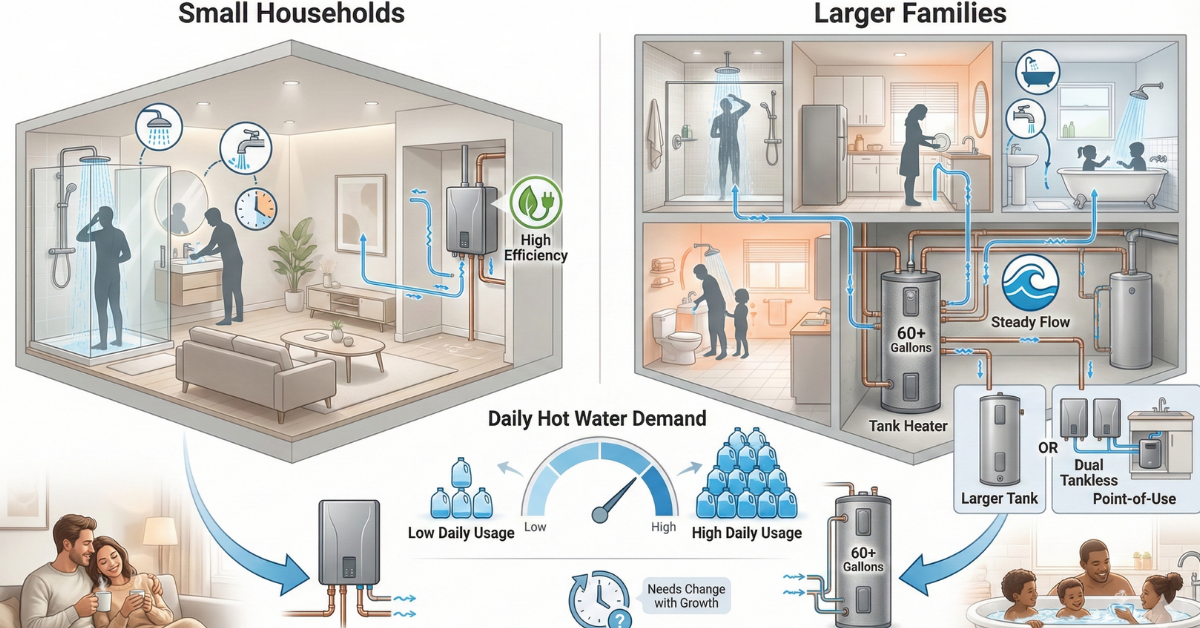
Your daily hot water usage plays a major role in choosing between tank and tankless systems.
Small Households (1 to 2 People)
Smaller households typically use 41 gallons or less per day, making tankless water heaters especially cost-effective. The energy savings of 24% to 34% add up quickly, and the compact size frees up space in utility closets or basements. A single tankless unit can easily handle showers, dishwashing, and laundry without running out of hot water.
Larger Families (3 or More People)
Larger families with high simultaneous hot water demand may benefit from a tank water heater’s stored capacity. If multiple showers run at once while the dishwasher cycles, a 50-gallon or larger tank provides reliable performance. Alternatively, some homeowners install two tankless units or add point-of-use tankless heaters for high-demand fixtures.
Not sure if your current system is still meeting your needs? Learn when to replace your water heater to avoid unexpected cold showers.
Are There Tax Credits or Rebates for Water Heaters?
Federal tax incentives can significantly reduce the cost of upgrading your water heater. According to ENERGY STAR, homeowners can claim 30% of project costs (including installation) for qualifying equipment through the end of 2025.
Gas tankless water heaters with a Uniform Energy Factor (UEF) of 0.95 or higher qualify for up to $600 in federal tax credits. Heat pump water heaters, which are highly efficient electric models, qualify for up to $2,000. These credits are separate from local utility rebates, which may offer additional savings. Check out our guide to HVAC tax incentives to learn more about available savings.
To claim these credits, file IRS Form 5695 with your tax return and keep all receipts and manufacturer certifications on file.
Ready to Upgrade Your Water Heater?
Choosing between a tankless vs. tank water heater comes down to your household’s hot water needs, budget, and long-term goals. Tank systems offer lower upfront costs and reliable performance for larger families, while tankless models deliver energy savings, unlimited hot water, and a longer lifespan.
If you are unsure which system fits your home, our team at Ridgeline Heating and Cooling can help. We will assess your hot water demand, evaluate your current setup, and recommend the right solution for your Idaho Falls home. Schedule a water heater consultation today to get a professional recommendation tailored to your needs.
Water heater on its last legs?
We handle water heater repair and replacement in Idaho Falls, including tankless conversions where the gas line and venting allow it.
Call (208) 521-2041 or request service online. Ridgeline Heating and Cooling, 370 College St, Idaho Falls, ID 83401.