Skip to content




A whole-house humidifier Installation keeps your indoor humidity between 30% and 50%, protecting your family’s health, reducing energy costs, and preventing damage to wood floors and furniture. For Idaho Falls homeowners dealing with dry winter air that can drop indoor humidity to 15% or lower, installing a whole-house humidifier is one of the most cost-effective upgrades you can add to your HVAC system. Here is what you need to know before making your decision.
Key Takeaways
- A whole-house humidifier maintains 30-50% indoor humidity across every room, reducing dry skin, sore throats, and respiratory irritation during Idaho’s long winters
- Research from the Mayo Clinic found that humidified rooms significantly reduce airborne influenza virus survival and infectivity
- Properly humidified air feels warmer, allowing you to lower your thermostat a few degrees and save 2-4% per degree on your heating bill
- Unlike portable units that treat one room, a whole-house humidifier connects to your HVAC system and typically requires just an annual filter change
- Installation costs range from $300 to $1,200, and a well-maintained unit lasts 10 to 15 years
What Is a Whole-House Humidifier and How Does It Work?
A whole-house humidifier is a device that connects directly to your home’s HVAC ductwork and water supply. Unlike portable humidifiers that only add moisture to a single room, a whole-house unit distributes humidity evenly through your entire home as your heating system runs. A built-in humidistat monitors indoor humidity levels and activates the humidifier automatically when moisture drops below your preset threshold.
Bypass, Fan-Powered, and Steam Humidifiers Explained
There are three main types of whole-house humidifiers, and each one works differently with your HVAC system:
- Bypass humidifiers use your furnace’s blower to push heated air through a water-soaked pad. The air picks up moisture and circulates it through your ductwork. These are the most affordable option and work well for homes up to 4,000 square feet.
- Fan-powered humidifiers operate similarly to bypass models but include a built-in fan. This allows them to run independently of your furnace blower and produce up to one extra gallon of moisture per day. They work well in homes with limited ductwork access. According to HVAC.com, the internal fan uses about the same electricity as a 25-watt light bulb.
- Steam humidifiers boil water to produce steam, which is then pushed through your ductwork. They are the most effective option for larger homes but use more electricity and cost more upfront.
Chris Houchin, co-owner of The Weather Changers in Denver, Colorado, recommends matching the humidifier type to your home’s layout. “If it is a single-story home, I tend to go with the fan or bypass humidifier,” Houchin told Bryant. For multi-story homes or those over 4,000 square feet, a steam humidifier may be the better choice.
Whole-House vs. Portable Humidifiers: Which Is Right for Your Home?
If you are deciding between a whole-house unit and multiple portable humidifiers, here is how they compare:
| Feature | Whole-House Humidifier | Portable Humidifier |
| Coverage | Entire home (all rooms) | One room at a time |
| Maintenance | Annual filter change | Weekly cleaning, daily refilling |
| Installation | Professional HVAC installation | Plug in and go |
| Humidity Control | Automatic via humidistat | Manual adjustment |
| Cost | $300-$1,200 installed | $30-$200 per unit |
| Lifespan | 10-15 years | 2-5 years |
| Noise | Quiet (integrated into ductwork) | Audible in room |
For most Idaho Falls homeowners with a forced-air HVAC system, a whole-house humidifier provides better long-term value, convenience, and consistent humidity control.

Why Do Idaho Falls Homes Need a Whole House Humidifier Installation?
Idaho Falls sits in eastern Idaho’s high desert climate, where dry conditions are a year-round reality. During the winter heating season, the problem gets significantly worse because cold air holds very little moisture to begin with, and running your furnace dries it out even further.
How Idaho’s Dry Climate Affects Your Indoor Air
According to the Western Regional Climate Center, Idaho’s humidity can drop to 15% or lower during peak conditions. Eastern Idaho, including the Idaho Falls area, has a more continental climate than western parts of the state, which means greater temperature extremes and drier air in both summer and winter.
When your furnace heats cold outdoor air, the relative humidity inside your home can plummet well below 30%. The EPA recommends maintaining indoor humidity between 30% and 50% for optimal health and comfort. Without a humidifier, most Idaho Falls homes fall short of that range for several months each year.
If you are already noticing dry conditions in your home, learning how to control your home’s humidity levels is the first step toward improving your indoor comfort.
What Happens When Indoor Humidity Drops Below 30%?
When your home’s humidity consistently stays below 30%, the effects show up quickly:
- Dry, cracked skin and chapped lips that moisturizers alone cannot fix
- Increased static electricity causing shocks, frizzy hair, and clingy clothing
- Sore throats and dry nasal passages that make you more vulnerable to infections
- Cracking in hardwood floors, furniture, and window frames as wood loses moisture
- Higher heating bills because dry air feels colder, prompting you to turn up the thermostat
Chris Pierret, Ph.D., a researcher at the Mayo Clinic’s Center for Clinical and Translational Science, has studied how humidity levels affect virus transmission. In a Mayo Clinic research summary, Pierret explained that his team was able to demonstrate a significant reduction in influenza virus survival through humidification during the driest winter months. He noted that these findings could have major implications not only for schools but also for businesses and homes.
What Are the Health Benefits of a Whole-House Humidifier?
Installing a whole-house humidifier can make a meaningful difference in your family’s health, especially during the cold and flu season that runs from October through March in Idaho Falls.
Reduced Respiratory Irritation and Allergy Symptoms
Dry indoor air irritates the mucous membranes in your nose and throat, making you more susceptible to colds, sinus infections, and allergy flare-ups. The Mayo Clinic recommends maintaining indoor humidity between 30% and 50% to help ease symptoms caused by dry air, including nasal congestion, dry cough, and sore throat.
A whole-house humidifier helps your respiratory system function the way it should. When your nasal passages stay hydrated, they are better equipped to trap allergens, dust particles, and bacteria before they reach your lungs. This is especially helpful for family members with asthma or seasonal allergies.
If you have ever noticed that high indoor humidity levels can also cause problems, you are right. The key is maintaining balance. A whole-house humidifier with an automatic humidistat prevents over-humidification, keeping your home in the ideal 30-50% range where neither dry air nor excess moisture creates issues.
How Humidity Helps Your Family Fight Flu and Cold Viruses
One of the most compelling reasons to install a whole-house humidifier is its potential to reduce the spread of airborne viruses in your home.
A study published in PLOS One, conducted at a preschool in Rochester, Minnesota, and supported by the Mayo Clinic, compared humidified and unhumidified classrooms during the peak of flu season. The results were striking. Humidified rooms showed a significant reduction in influenza-positive air and surface samples compared to unhumidified rooms.
Jennifer Reiman, Ph.D., a Mayo Clinic researcher and the study’s lead author, summarized the findings by noting that humidification reduced the amount of flu detected in the air, which is the primary transmission route, as well as on surfaces, which serve as a secondary pathway for infection. These results were reported by ACHR News.
A separate study by the National Institute for Occupational Safety and Health (NIOSH), part of the CDC, found that at humidity levels of 43% or higher, airborne flu virus infectivity dropped to just 15-22%. At humidity below 23%, infectivity remained at 71-77%. Most of that viral inactivation happened within the first 15 minutes of exposure to higher humidity.
For Idaho Falls families, maintaining proper indoor humidity during the winter is not just about comfort. It is a practical step you can take to help protect your household during flu season.

Can a Whole-House Humidifier Lower Your Energy Bills?
Yes. A whole-house humidifier can help you reduce heating costs by making your home feel warmer at lower thermostat settings. This is one of the benefits that pays for itself over time.
Why Humid Air Feels Warmer at Lower Thermostat Settings
Humid air retains heat more effectively than dry air. When your indoor air has proper moisture content, your body perceives the temperature as warmer, even if the thermostat reading stays the same. This is the same principle that makes a humid summer day feel hotter than the actual temperature.
During winter, this works in your favor. With a whole-house humidifier maintaining 35-45% humidity, many homeowners find they can lower their thermostat by two to four degrees without sacrificing comfort.
How Much Can Idaho Falls Homeowners Save?
According to energy efficiency research, every degree you lower your thermostat in winter can save between 2% and 4% on your heating bill. If you lower your thermostat by three degrees, that translates to potential savings of 6-12% on monthly heating costs.
The EPA has noted that residential humidifiers account for only about 0.11% of overall household electricity use, making the energy cost of running a humidifier negligible compared to the heating savings it enables.
Here is a quick look at the potential numbers for an Idaho Falls home:
| Scenario | Monthly Heating Cost | Annual Savings |
| No humidifier (thermostat at 72°F) | $200 | $0 |
| With humidifier (thermostat at 69°F) | $176-$188 | $144-$288 |
| Humidifier electricity cost | +$2-$5/month | -$24-$60 |
| Net annual savings | $84-$228 |
Savings estimates are based on published industry data and will vary depending on home size, insulation quality, and heating system efficiency.
When you combine energy savings with the reduced wear on your HVAC system from running at lower temperatures, a whole-house humidifier often pays for itself within two to four years.
How Does a Humidifier Protect Your Home and Furniture?
Beyond health and energy savings, a whole-house humidifier helps preserve the structural integrity and appearance of your home’s interior.
Preventing Cracks in Wood Floors, Furniture, and Window Frames
Wood is highly sensitive to moisture levels. When indoor humidity drops below 30% for extended periods, hardwood floors can develop gaps between boards, furniture joints can loosen and crack, and window frames can warp.
According to wood flooring industry recommendations, maintaining relative humidity between 35% and 55% helps preserve the look, structure, and longevity of hardwood floors. A whole-house humidifier keeps moisture levels consistent throughout your home, preventing the dry-wet cycling that causes the most damage to wood over time.
For Idaho Falls homeowners who have invested in hardwood flooring, quality furniture, or musical instruments like guitars or pianos, a humidifier acts as a protective safeguard for those investments.
Reducing Static Electricity Throughout Your Home
If you are getting shocked every time you touch a doorknob or light switch during winter, low humidity is the cause. Dry air allows electrical charges to build up on surfaces and clothing. When you make contact with a conductive surface, that charge discharges as a static shock.
A whole-house humidifier adds enough moisture to the air to dissipate those charges before they build up. According to Kliemann Brothers Heating and Air Conditioning, moist air contains more charged particles than dry air, which helps neutralize static electricity and prevents uncomfortable shocks, frizzy hair, and clingy clothing.
What Does Whole-House Humidifier Installation Involve?
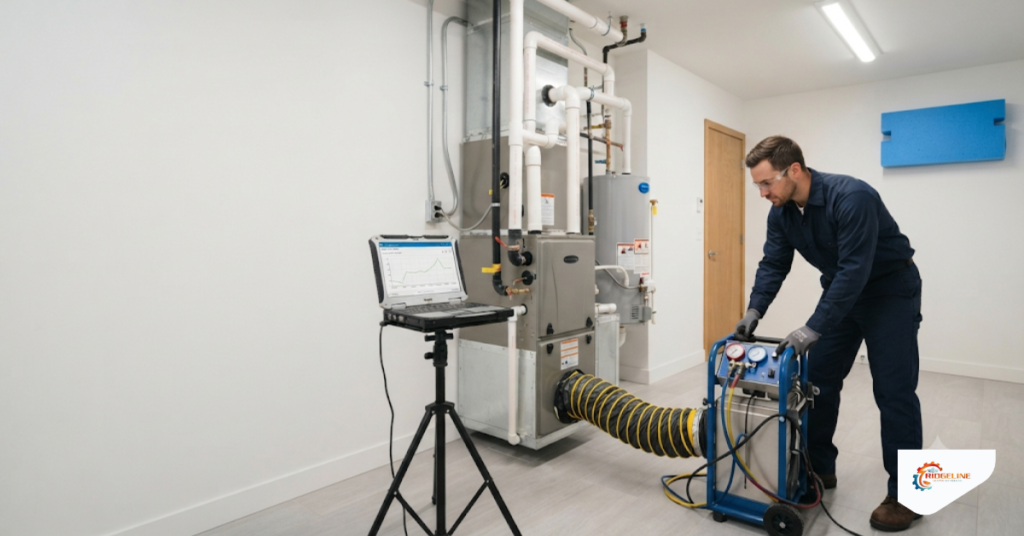
Installing a whole-house humidifier is a job best handled by a licensed HVAC contractor. The process involves connecting the unit to your ductwork, water supply, and electrical system, and improper installation can lead to water leaks, mold growth, or damage to your heating system.
The Professional Installation Process
A typical whole-house humidifier installation follows these steps:
- Assessment – Your HVAC technician evaluates your home’s size, existing ductwork, and heating system to recommend the right humidifier type and capacity
- Mounting – The humidifier unit is mounted on the supply or return air plenum near your furnace
- Water connection – A water line is connected from your home’s plumbing to the humidifier
- Electrical wiring – The humidistat and control wiring are connected to your furnace’s control board
- Testing – The technician verifies proper operation, checks for leaks, and sets your desired humidity level
According to Carrier, homeowners can expect to spend between $300 and $1,200 for the unit and professional installation, depending on the humidifier type, home size, and any modifications needed for plumbing or electrical connections.
Most installations are completed in a single visit, typically within two to four hours.
Maintenance Requirements and Expected Lifespan
One of the biggest advantages of a whole-house humidifier over portable units is how little maintenance it requires. Here is what to expect:
- Annual filter/water panel replacement – The evaporator pad or water panel should be replaced once per year, typically at the start of the heating season. In areas with hard water, you may need to replace it every six months.
- Seasonal inspection – Have your HVAC technician inspect the humidifier during your regular HVAC maintenance visit each fall.
- End-of-season shutdown – At the end of winter, drain the system, clean components, and close the bypass damper (if applicable) to prevent unnecessary moisture during cooling season.
With consistent maintenance, a whole-house humidifier typically lasts 10 to 15 years before needing replacement. Enrolling in a heating maintenance plan ensures your humidifier gets checked alongside your furnace each year, extending its lifespan and keeping performance consistent.
Ready to Improve Your Indoor Comfort This Winter?
Dry indoor air does not have to be something your family just lives with. A whole-house humidifier installation improves your health, protects your home, and can save you money on energy bills every winter.
If you are noticing dry skin, frequent static shocks, cracking wood, or rising heating costs in your Idaho Falls home, it may be time to explore your humidifier and dehumidifier services options.
Ridgeline Heating and Cooling is here to help you find the right whole-house humidifier for your home. Our licensed HVAC technicians will assess your system, recommend the best fit, and handle every step of the installation. Contact us today to schedule your consultation and take the first step toward a more comfortable, healthier home.