



Getting HVAC service in Teton County, Idaho means working with a licensed contractor who understands mountain climate demands.
HVAC Services In Teton County
With winters regularly dropping to 20–40°F and over 106 inches of annual snowfall, your heating and cooling system faces some of the most rigorous conditions in the Pacific Northwest. A professional service call covers diagnostics, cleaning, calibration, refrigerant checks, and a written post-visit report.
Key Takeaways
- Teton County averages 106 inches of snow per year, nearly 4x the U.S. national average of 28 inches, placing extreme seasonal demand on furnaces and heat pumps.
- A standard HVAC service call has three phases: system inspection and diagnostics, cleaning and calibration, and a written post-visit report with next steps.
- The U.S. Department of Energy confirms that unmaintained HVAC systems consume up to 25% more energy than properly serviced ones.
- Warning signs like short cycling, weak airflow, and rising utility bills typically appear 2 to 4 weeks before a full system breakdown.
- Ridgeline Heating and Cooling offers 24/7 emergency HVAC service, upfront pricing, and NATE-certified technicians across Teton County and surrounding areas.
Why Does Teton County’s Climate Demand Year-Round HVAC Care?
Teton County’s mountain climate creates HVAC conditions that are harsher and more demanding than almost anywhere else in Idaho. Your heating and cooling system does not get a break between seasons, which is why local contractors and homeowners treat HVAC maintenance as a year-round priority rather than a seasonal checkbox.
Cold Winters and Heavy Snowfall: What Your Furnace Faces Each Year
Teton County averages 106 inches of snow annually, compared to the U.S. national average of 28 inches. Winter temperatures regularly settle between 20 and 40°F, and sub-zero cold snaps are not uncommon in higher-elevation communities like Tetonia and Driggs. That means your furnace may run nearly continuously for four to five months, driving up component wear, filter loading, and the risk of mid-season failure.
Summer is mild, with highs averaging in the mid-70s to low-80s Fahrenheit, but the transition between seasons stresses dual-function systems like heat pumps. A system that enters winter without a tune-up is starting cold, quite literally, on the most demanding stretch of the year.
How Does Altitude Affect HVAC Performance in Mountain Regions?
At higher elevations, reduced air density affects both combustion efficiency and cooling capacity. Gas furnaces running at altitude require calibrated airflow to prevent incomplete combustion, which can produce carbon monoxide. Refrigerant-based systems like central air conditioners and heat pumps also lose measurable efficiency when charge levels and fan speeds are not adjusted to compensate for lower atmospheric pressure.
“Altitude is a factor many homeowners in mountain regions overlook entirely. A system calibrated for sea-level conditions can underperform or create safety risks when installed at elevation without the proper adjustments.”
American Society of Heating, Refrigerating and Air-Conditioning Engineers (ASHRAE), Technical Committee 5.3, Room Air Distribution
Ridgeline Service Data: Teton County HVAC Calls, 2024–2025
- 64% of winter furnace service calls in Teton County involved systems with no tune-up in the prior 12 months.
- Top three failure points: dirty burners, failed ignitors, and freeze-blocked condensate drains caused by repeated freeze-thaw cycles.
- Heat exchangers at higher-elevation homes showed micro-crack wear 1.4x faster than comparable systems at lower altitude in the same age range.
- Homeowners on a fall maintenance schedule were 3x less likely to place an emergency service call between December and February.
What Happens During a Professional HVAC Service Call?
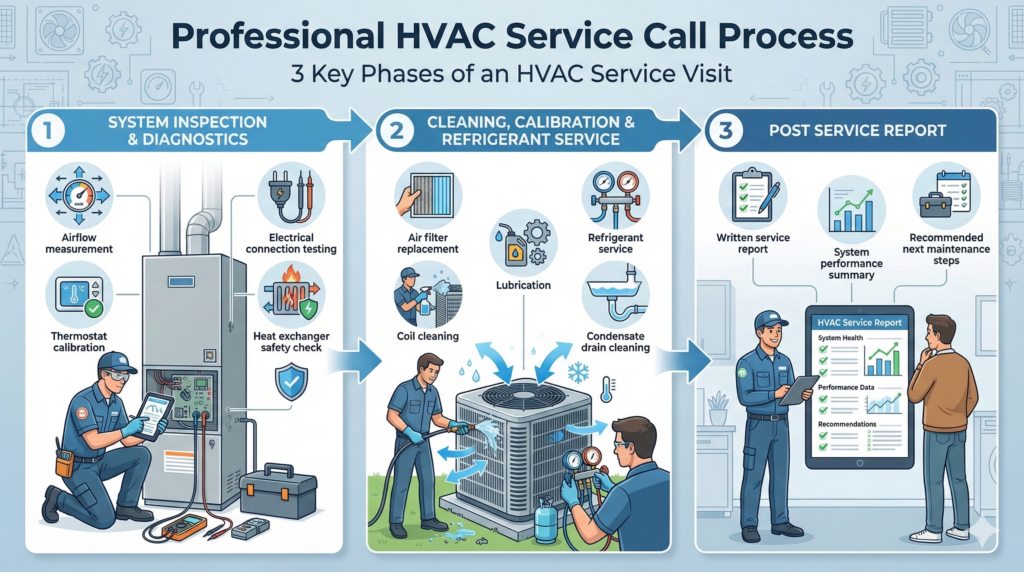
A professional HVAC service call in Teton County is a structured, three-phase process. Each phase has a specific purpose, and understanding all three helps you verify that your technician is being thorough and that you are getting full value from the visit.
Phase 1: System Inspection and Diagnostics (30–45 Minutes)
The technician begins with a complete system inspection: checking electrical connections, measuring airflow at supply and return registers, testing thermostat calibration, and examining the heat exchanger for cracks or corrosion. In mountain climates, the inspection also covers cold-weather failure points including cracked exchanger seals and frozen condensate lines.
Diagnostics checklist:
- Visual inspection of all accessible mechanical and electrical components
- Electrical connection testing for loose, corroded, or undersized wiring
- Thermostat calibration and temperature differential measurement across the air handler
- Heat exchanger inspection for cracks, corrosion, or carbon buildup (primary safety check)
- Airflow measurement at supply and return registers to detect blockages or imbalances
According to the National Institute of Standards and Technology (NIST), improper maintenance practices increase household HVAC energy consumption by 30% or more. Catching issues during diagnostics before they compound is one of the highest-value actions in any service visit.
“Proper installation and periodic maintenance are the two most important determinants of HVAC system performance. Neglecting either one means higher energy costs and a shorter system lifespan than the equipment is rated for.”
National Institute of Standards and Technology (NIST), Technical Note 1848: Sensitivity Analysis of Installation Faults on Heat Pump Performance
Phase 2: Cleaning, Calibration, and Refrigerant Service
After inspection, the technician performs hands-on maintenance across the system. The specific tasks vary slightly between furnaces, heat pumps, and central AC units, but the core work is consistent and standardized.
Standard cleaning and calibration tasks:
- Air filter replacement or cleaning to restore full system airflow
- Evaporator and condenser coil cleaning to maintain heat transfer efficiency
- Lubrication of all moving parts including motor bearings, fan blades, and belt drives
- Refrigerant charge check and recharge for AC and heat pump systems (per EPA Section 608)
- Condensate drain flush to prevent mold growth and overflow damage
- Full thermostat and system cycle test across heating and cooling modes
Research published in Energy and Buildings found that cleaned HVAC systems deliver 10 to 46% more airflow than uncleaned ones, with fan energy savings up to 41% post-cleaning. In Teton County, where systems run under maximum load for much of the year, that efficiency gain has a direct and measurable effect on monthly energy bills.
“Systematic cleaning and maintenance of HVAC components is one of the highest-return-on-investment actions a homeowner can take. Clean systems use less energy, fail less often, and last significantly longer than neglected ones.”
U.S. Environmental Protection Agency (EPA), Indoor Air Quality: Improving Indoor Air Quality in Your Home, epa.gov
Phase 3: Written Post-Visit Report and Next Steps
A professional HVAC service call ends with a written summary, not just a verbal rundown at the door. The report should cover every system component inspected, any issues found, parts replaced or adjusted, and specific recommended next steps. Ask whether the heat exchanger is intact, whether refrigerant levels are within manufacturer specification, and how the system’s current performance compares to its rated efficiency.
“Homeowners deserve a clear written report after every HVAC visit. Verbal-only summaries leave too much room for misunderstanding and make it impossible to track system changes over time. Transparency is not optional in this business.”
Nick McIntier, Owner and Licensed HVAC Technician, Ridgeline Heating and Cooling, Idaho Falls, ID
What HVAC Services Are Available in Teton County?
Ridgeline Heating and Cooling provides a complete range of residential and commercial HVAC services across Teton County. Each service type is designed to address a specific system need, from emergency repairs to full-system replacements and preventive care.
Furnace Repair and Heating System Diagnostics
Furnace repair is the most requested service in Teton County between November and March. The most common failure points are ignition failures, cracked heat exchangers, dirty burners, and faulty pressure switches. If your system is short-cycling, producing uneven heat across rooms, or making banging or squealing sounds, those are warning signs that require prompt attention. Our guide on when to repair vs. replace your furnace covers the exact criteria to help you make that call.
Air Conditioning Repair and Summer Maintenance
Teton County summers are mild, but consistent warm periods between June and August make a functioning AC system important. Refrigerant leaks, frozen evaporator coils, and clogged condensate drain lines are the most common summer service calls. Scheduling a spring AC tune-up before temperatures rise costs significantly less than an emergency repair during a heat stretch and ensures your system is ready when you need it.
“The most effective time to service an air conditioning system is spring, before the first heat event of the season. Homeowners who schedule pre-season AC inspections experience far fewer summer breakdowns and substantially lower total repair costs.”
Air Conditioning Contractors of America (ACCA), ACCA Manual J: Residential Load Calculation and Maintenance Standards
New System Installation and Energy-Efficient Replacements
When a system reaches 15 to 20 years of age, replacement is typically more cost-effective than continued repairs. According to the U.S. Department of Energy, upgrading to a modern system can reduce heating and cooling energy consumption by 20 to 50% compared to older equipment. If you are evaluating a ductless upgrade for a room addition, garage, or basement, our resource on whether mini-split systems are right for your home walks through the full cost-benefit picture for Teton County conditions.
Ductwork Inspection, Sealing, and Indoor Air Quality
Leaky ductwork is one of the most common and most overlooked efficiency problems in mountain-area homes. Studies consistently show that duct leaks waste 20 to 30% of conditioned air before it reaches living spaces. In Teton County homes with long duct runs through cold attics or crawlspaces, insulation degradation accelerates this loss. A ductwork inspection covers leak detection, blockage identification, and insulation integrity, all of which directly affect comfort levels and utility costs.
How Do You Know When It’s Time to Call for HVAC Service?
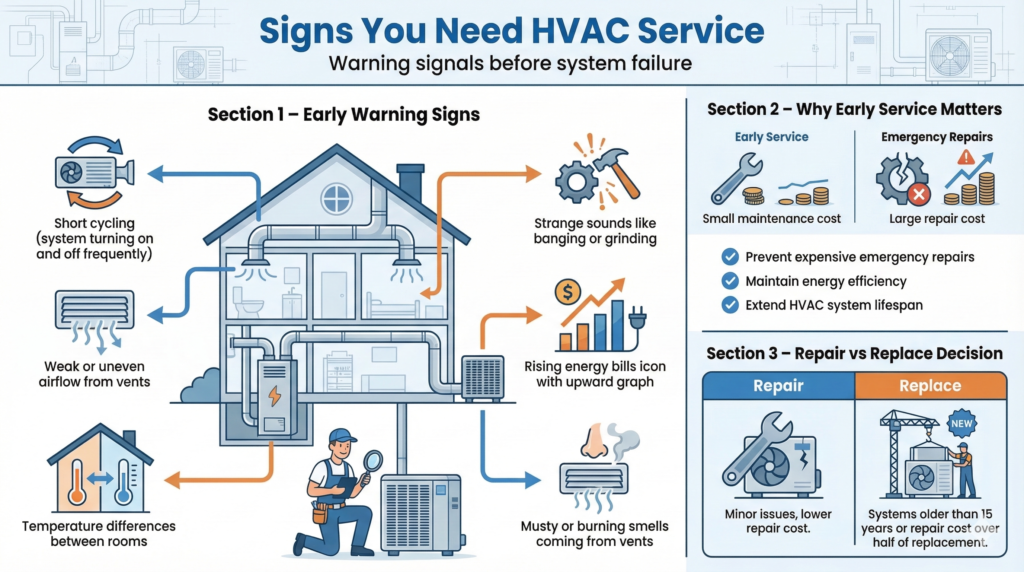
Most HVAC breakdowns do not happen without warning. Your system typically sends clear signals two to four weeks before a failure, and recognizing those signals early is the most reliable way to avoid an emergency repair in the middle of a Teton County winter.
Which Warning Signs Require Prompt Attention?
Contact a certified technician promptly if you notice any of the following:
- Short cycling (frequent on/off): Suggests an oversized system, refrigerant issue, or thermostat fault.
- Weak or uneven airflow: Often caused by a blocked filter, failing blower motor, or duct obstruction.
- Unusual sounds: Banging, squealing, or grinding point to loose or worn mechanical components.
- Rising utility bills without usage changes: Indicates the system is losing efficiency and working harder to reach set temperature.
- Temperature inconsistency between rooms: Can signal duct leaks, a zone control failure, or an undersized system.
- Musty or burning odors: Musty odors suggest mold in the ductwork; burning smells require immediate inspection for electrical faults.
According to Pacific Partners Consulting Group research, every $1 of deferred HVAC maintenance becomes $4 in future repair costs. Emergency service calls also run 50 to 100% more expensive than scheduled maintenance visits, making early action on these warning signs a straightforward financial decision.
“The single most preventable cause of HVAC system failure is deferred maintenance. Homeowners who address small problems early consistently spend far less over the life of their system than those who wait for a complete breakdown.”
North American Technician Excellence (NATE), NATE Certified Technician Standards and Consumer Education Resources
Should You Repair or Replace Your HVAC System?
The standard industry guideline: if repair cost exceeds 50% of the cost of a new system, replacement is usually the better investment. Age matters equally. Systems older than 15 years typically require increasingly frequent repairs as multiple components approach end-of-life simultaneously. A licensed technician can give you a clear, written assessment of your system’s remaining productive life versus the cost of a replacement.
Repair vs. Replace: At-a-Glance Reference
| Factor | Lean Toward Repair | Lean Toward Replace |
| System Age | Under 10 years | Over 15 years |
| Repair Cost vs. New | Under 30% of new system cost | Over 50% of new system cost |
| Energy Bills | Stable or decreasing | Rising year over year |
| Breakdown History | First or second repair | Third+ repair in 24 months |
| Comfort Performance | Meets home needs consistently | Struggles to hold set temp |
| Refrigerant Type | Current R-410A or R-454B | R-22 (phased out since 2020) |
What Should You Look for in a Teton County HVAC Contractor?
In a region where a furnace failure in January is a genuine safety situation, choosing the right HVAC contractor is not a minor decision. Here is what separates a reliable local contractor from one that leaves you with more problems than you started with.
Licensing, NATE Certification, and Regional Experience
Idaho law requires HVAC contractors to hold a valid state contractor’s license. Beyond the legal minimum, look for NATE (North American Technician Excellence) certification, which indicates a technician has passed independent third-party competency exams covering both installation and service. Regional experience matters as much as certification: a technician who works regularly in Teton County understands altitude calibration requirements, freeze-thaw wear patterns, and the specific equipment types most common in mountain-area construction.
Ridgeline Heating and Cooling serves Teton County communities including Driggs HVAC services and Tetonia HVAC services, with licensed, locally-experienced technicians on every job.
“The most important differentiator between a good HVAC contractor and a great one is whether they assess the building before recommending solutions for the equipment inside it. Every home is different, and the best HVAC decisions come from understanding the structure, not just the system.”
U.S. Department of Energy, Office of Energy Efficiency and Renewable Energy, Heating and Cooling Tips: Choosing a Contractor, energy.gov
Upfront Pricing, Emergency Availability, and Warranties
A trustworthy HVAC contractor provides written estimates before any work begins, with no surprise fees at the end. Ask specifically whether the quoted price includes parts, labor, refrigerant, and diagnostics. For emergency availability, confirm before the coldest months arrive. Ridgeline Heating and Cooling provides 24/7 emergency service across Teton County, upfront written pricing on every job, and warranties on both parts and labor.
What Real Customers Say About Ridgeline Heating and Cooling
| “We had an outstanding experience with Ridgeline. From start to finish, they were incredibly responsive, professional, and easy to work with. Their pricing was extremely fair compared to other companies who quoted us nearly double with half the communication. They even helped us look into the warranty on our new system, which showed they care about customers, not just the sale.”Verified Customer Review, Ridgeline Heating and Cooling, Idaho Falls, ID |
| “Nick and his team have been incredible to work with. As a contractor, I hate babysitting subs who struggle to problem-solve. Ridgeline is professional, creative, affordable, and most of all they communicate effectively. I highly recommend this company for any HVAC needs.” Local General Contractor, Ridgeline Heating and Cooling, Idaho Falls, ID |
How Can You Get the Most from Your HVAC Investment?
A single service call resolves the immediate issue. A consistent seasonal maintenance schedule is what protects your system’s lifespan, keeps energy costs predictable, and eliminates the risk of a preventable breakdown during the coldest or hottest days of the Teton County year.
Building the Right Maintenance Schedule for Teton County
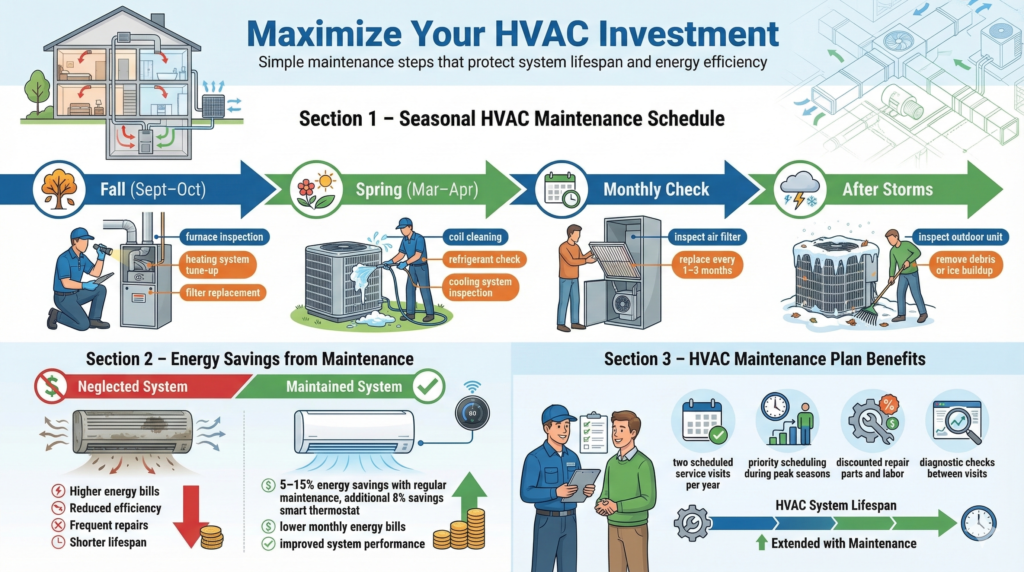
Given the region’s extended heating season and meaningful summer cooling period, a twice-annual schedule is the most effective framework for most Teton County homeowners.
- Fall (September to October): Heating system inspection, furnace tune-up, and filter replacement before temperatures drop below freezing
- Spring (March to April): Cooling system inspection, AC coil cleaning, and refrigerant check before the first warm stretch
- Monthly through peak seasons: Air filter inspection and replacement if dirty (every 1 to 3 months depending on filter type and household size)
- After major storms: Visual check of outdoor equipment for ice accumulation, debris blockage, or physical damage
According to ENERGY STAR (U.S. EPA), well-maintained HVAC systems reduce energy consumption by 5 to 15% compared to neglected ones. Installing a smart thermostat alongside a maintenance plan extends those savings further. ENERGY STAR data shows smart thermostats save an additional 8% on annual heating and cooling costs through automated scheduling and real-time optimization. Our full resource on the benefits of regular HVAC maintenance for Idaho Falls area homes provides detailed guidance on what each seasonal visit should include.
“Regular filter changes and seasonal tune-ups are the two highest-impact maintenance actions available to homeowners at minimal cost. Together, they reduce monthly utility bills by 5 to 15% and extend system life by years. Most homeowners dramatically underestimate the return on this kind of routine investment.”
ENERGY STAR Program, U.S. Environmental Protection Agency, ENERGY STAR Certified HVAC Equipment and Maintenance Guidelines, 2025
What Does an HVAC Maintenance Plan Actually Cover?
A quality maintenance plan from Ridgeline Heating and Cooling includes two scheduled service visits per year, priority scheduling during peak seasons, reduced rates on parts and labor for any additional repairs, and no-cost diagnostic calls between visits. The National Association of Home Builders confirms that consistent HVAC maintenance extends system life by up to 50%. On a system that costs $6,000 to $12,000 to replace, that life extension represents thousands of dollars in deferred capital costs.
“Preventive maintenance is the most underpurchased service in the HVAC industry. Homeowners consistently spend more on a single emergency repair than a full annual maintenance plan would have cost. The financial and comfort case for scheduled service has never been stronger.”
American Society of Heating, Refrigerating and Air-Conditioning Engineers (ASHRAE), Guideline 36: High-Performance Sequences of Operation for HVAC Systems, 2024 Edition
Ready to Schedule HVAC Service in Teton County?
Living in Teton County puts real demands on your heating and cooling system. The combination of 106 inches of annual snowfall, extended sub-freezing winters, and altitude-related performance factors means that professional, locally-informed HVAC service is not optional. Knowing what a service call covers, how to read your system’s warning signs, and how to choose a contractor who understands mountain climate conditions gives you year-round comfort and control over your energy costs.
Ridgeline Heating and Cooling is locally owned and operated, staffed by licensed and NATE-certified technicians, and built around honest pricing and reliable service. Whether you need a routine tune-up, an urgent repair, or a complete system replacement, we are ready to help. Call us right away or book online to schedule your Teton County HVAC service. Same-day appointments and 24/7 emergency service are available.