Skip to content





Most Idaho Falls homes need about 1 ton of air conditioning per 500-600 square feet, plus 40-45 BTU per square foot for heating. A typical 2,000 sq ft home in the Idaho Falls area needs roughly a 3 to 3.5 ton AC unit paired with an 80,000 to 90,000 BTU furnace. But square footage alone gives you only a starting point. Your insulation, window quality, ceiling height, and Idaho’s cold Zone 6 climate all change the final number.
Getting the size right matters more than most homeowners realize. According to U.S. Department of Energy data, over 60% of residential HVAC systems are incorrectly sized, and that single mistake costs families thousands in wasted energy and early equipment replacement. This guide walks you through the math, the factors that change it, and when to bring in a local expert.
Key Takeaways
- Cooling rule of thumb: 1 ton (12,000 BTU) per 500-600 sq ft in Idaho Falls
- Heating rule of thumb: 40-45 BTU per sq ft for cold Climate Zone 6
- Typical 2,000 sq ft home: 3-3.5 ton AC and 80,000-90,000 BTU furnace
- Manual J load calculation is the industry standard for accurate sizing
- Oversized systems cause short cycling, sticky humidity, and higher bills
- Standard residential sizes come in 0.5-ton increments: 1.5, 2, 2.5, 3, 3.5, 4, 4.5, and 5 tons
How Do You Calculate What Size HVAC System Your Home Needs?
Sizing an HVAC system means matching your home’s heating and cooling load to a unit that can handle that load efficiently. The load is measured in BTUs (British Thermal Units) per hour. One ton of cooling equals 12,000 BTUs per hour, which is the standard unit air conditioner manufacturers use.
The Square Footage Rule of Thumb
The simplest starting point is BTU per square foot. The baseline most installers reference is 20 BTU per square foot of living space for cooling. Multiply your square footage by 20, then divide by 12,000 to get your ton estimate.
For a 1,800 sq ft home, that math looks like this: 1,800 × 20 = 36,000 BTU, divided by 12,000 = 3 tons. This rule works as a quick check but ignores insulation, climate, and window quality, so it should never be your final answer.
Climate Zone Adjustment for Idaho Falls
Idaho Falls sits in IECC Climate Zone 6, which the U.S. Department of Energy classifies as cold. In cold climates, heating load is typically 1.5 to 2 times the cooling load. That changes how you size your furnace compared to a home in Phoenix or Atlanta.
For heating in Idaho Falls, plan on 40-45 BTU per square foot. A 2,000 sq ft home would need around 80,000-90,000 BTU of heat output. Because winters here regularly drop below zero, sizing your furnace correctly is more critical than sizing your AC. A furnace that runs short on the coldest night of the year leaves your family cold; an AC that runs short for one hot afternoon is uncomfortable but not dangerous.
Why Manual J Is the Gold Standard
The Air Conditioning Contractors of America (ACCA) created Manual J, the ANSI-recognized national standard for sizing residential HVAC systems. Manual J accounts for the things rules of thumb cannot, including:
- Exact insulation R-values in walls, attic, and floors
- Window type, size, orientation, and shading
- Air infiltration through doors, ductwork, and gaps
- Number of occupants and heat-generating appliances
- Local design temperatures specific to your zip code
A proper Manual J calculation takes one to two hours and costs $200-500 if done as a standalone service. Most reputable Idaho Falls contractors include it free with installation quotes.
Need this handled in Idaho Falls? See our AC installation page or call (208) 521-2041.
What Size AC Unit Do I Need Based on Square Footage?
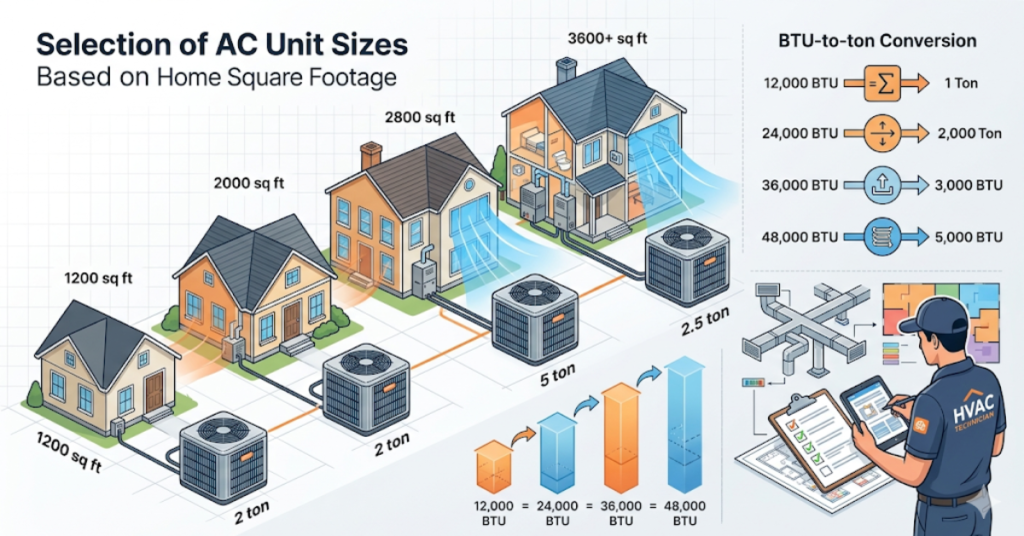
Residential AC units come in fixed sizes: 1.5, 2, 2.5, 3, 3.5, 4, 4.5, and 5 tons. You will not find a 2.83-ton unit on the market. When your calculation falls between sizes, your installer should round up only enough to cover peak demand without oversizing.
HVAC Sizing Chart by Home Size
This chart assumes average insulation, 8-foot ceilings, and Climate Zone 6 conditions like Idaho Falls. Your actual size may shift up or down based on home-specific factors.
| Home Size (sq ft) | AC Size (tons) | Cooling BTU | Furnace BTU Output |
| 1,000-1,200 | 2 tons | 24,000 | 48,000-54,000 |
| 1,200-1,500 | 2.5 tons | 30,000 | 60,000-67,500 |
| 1,500-2,000 | 3 tons | 36,000 | 67,500-90,000 |
| 2,000-2,500 | 3.5 tons | 42,000 | 90,000-112,500 |
| 2,500-3,000 | 4 tons | 48,000 | 112,500-135,000 |
| 3,000-3,500 | 4.5 tons | 54,000 | 135,000-157,500 |
| 3,500-5,000 | 5 tons or dual system | 60,000+ | 157,500+ |
Homes over 3,000 sq ft often work better with two separate systems or zoned equipment for even comfort. Our complete AC installation guide for Idaho Falls covers zoning options in more detail.
Converting BTUs to Tons
The math is simple: divide total BTUs by 12,000 to get tons. A 36,000 BTU unit is 3 tons. A 48,000 BTU unit is 4 tons. You can also read this from the model number on your existing outdoor unit, where the numbers 24, 30, 36, 42, 48, and 60 represent the BTU capacity in thousands.
What Size Furnace Do I Need for an Idaho Falls Home?
Furnace sizing in Idaho Falls is heating-dominated, which means the furnace usually carries more BTU capacity than the AC paired with it. The output BTU you actually deliver to the home depends on both input rating and efficiency.
Heating BTU Factor for Cold Climates
For Climate Zone 6, use 40-45 BTU per square foot of heated space. A 1,800 sq ft home with average insulation needs roughly 72,000-81,000 BTU of usable heat output. A well-insulated newer home can size 10-15% smaller. A drafty older home with single-pane windows may need 15-25% more capacity.
If you are weighing whether your current furnace is worth keeping, see our guide on when to repair vs replace your furnace before sizing a new one.
How Furnace Efficiency Affects Sizing
Furnaces are rated by both input BTU (gas consumed) and AFUE (efficiency percentage). The output you care about is input × AFUE.
- An 80,000 BTU furnace at 80% AFUE delivers 64,000 BTU of heat
- An 80,000 BTU furnace at 96% AFUE delivers 76,800 BTU of heat
Higher efficiency means more usable heat from the same gas burn. If you are replacing an older 80% furnace with a 95-96% AFUE model, you may be able to drop one input size and still get the same heat output, lowering your gas bill in the process.
What Factors Change Your HVAC Sizing Needs?
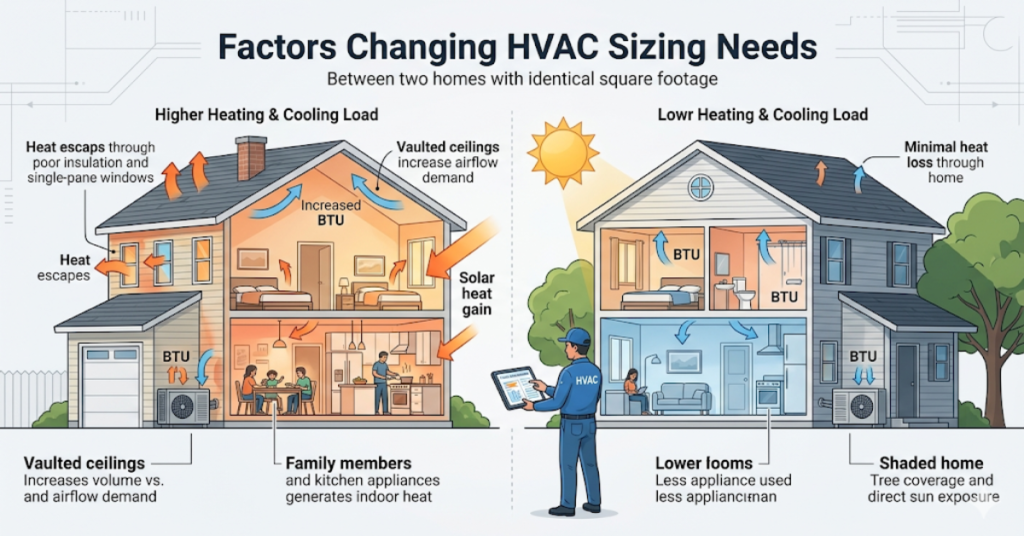
Two homes with identical square footage can need wildly different system sizes. One HVAC pro tracked 50 sizing jobs in a year and found only 12% of homes actually fit the standard 500 sq ft per ton rule. The rest needed anywhere from 350 to 900 sq ft per ton depending on construction and climate.
Insulation and Window Quality
Insulation is the single biggest variable after square footage. Poor insulation can increase your heating and cooling load by 25-30%. A 2,000 sq ft home with R-13 walls and R-30 attic insulation needs much less capacity than the same home with R-7 walls and R-19 attic.
Windows matter almost as much. Single-pane windows leak heat at three to four times the rate of modern double-pane Low-E glass. Large south- and west-facing windows also add significant solar gain in summer, pushing cooling needs higher.
Ceiling Height and Home Layout
Standard sizing charts assume 8-foot ceilings. For every extra foot of ceiling height, add about 1,000 BTU/hr per room. A great room with vaulted 12-foot ceilings can add 4,000-6,000 BTU to your total cooling load.
Two-story homes generally place less cooling load on the downstairs system because the upper floor acts as additional insulation. Open floor plans, on the other hand, mix conditioned air more easily but make zoning harder.
Sun Exposure and Occupancy
Each person in the home generates about 400-600 BTU/hr of body heat. A family of five adds the heat equivalent of a small space heater running constantly. Kitchens add roughly 4,000 BTU/hr during cooking hours. South-facing homes pick up more solar heat than north-facing ones, and homes with no tree cover need more cooling capacity than shaded properties.
What Happens If Your HVAC System Is the Wrong Size?
Wrong-size HVAC systems are the most common installation problem in residential homes, and they cost families money for the entire 15-20 year life of the equipment.
Problems With an Oversized System
Bigger is not better when it comes to HVAC. An oversized AC cools the air around the thermostat too quickly, shuts off before the rest of the house catches up, and never runs long enough to pull humidity out of the air. This is called short cycling.
Short cycling causes a chain of problems. Your home stays cool but feels muggy and sticky. The Mayo Clinic recommends keeping indoor humidity between 40% and 50% for comfort, and oversized units routinely push humidity above 60%. Compressors draw 6-10 times normal current at startup, so frequent cycling burns more electricity than steady operation. Oversizing wastes 20-30% more energy and can cut equipment lifespan in half, dropping a normal 15-20 year system to 8-10 years.
If you suspect short cycling, our guide on why your AC may be blowing humid air walks through the symptoms and fixes.
Problems With an Undersized System
Undersized systems run constantly without ever reaching your target temperature. The compressor wears out faster from continuous operation, electric bills climb because the unit never gets to rest, and on the hottest summer days or coldest winter nights, the system simply cannot keep up.
In Idaho Falls, an undersized furnace is the more dangerous problem. A unit that cannot meet load on a sub-zero night risks frozen pipes and unsafe indoor temperatures. This is why sizing the heating side conservatively, with a small safety margin, makes sense in our climate.
Should You Trust an Online Calculator or Call a Pro?
Online HVAC sizing calculators are useful for one thing: getting a ballpark number before you call contractors. They help you spot a quote that is obviously wrong, like a 6-ton system for a 1,500 sq ft house. But they cannot replace a professional Manual J calculation for a real installation.
Here is when each makes sense:
- Online calculator: Budget planning, comparing initial quotes, or sanity-checking a contractor’s recommendation
- Professional Manual J: Any new installation, major remodel, replacement after insulation upgrades, or new construction
- In-home assessment: Anytime you are spending $5,000+ on equipment that will run for 15-20 years
The cost difference between a 3-ton and 3.5-ton system is small. The cost difference between a system that runs well for 20 years and one that fails in 8 is enormous. For homeowners considering smaller, more flexible options, mini-split systems offer zoned comfort that sidesteps some sizing trade-offs entirely.
Once your system is properly sized and installed, regular HVAC maintenance keeps it running at peak capacity and protects the lifespan you paid for.
Get the Right Size HVAC System in Idaho Falls
Sizing an HVAC system is not guesswork, and it is not a one-number rule. The right system for your Idaho Falls home depends on your square footage, your insulation, your windows, your ceiling height, and how cold it gets during the coldest week of the year. A proper Manual J calculation captures all of that and gives you a system that runs efficiently, lasts longer, and keeps your family comfortable year-round.
If you want help sizing a new system, planning a replacement, or lowering your heating bill with the right equipment, the Ridgeline Heating and Cooling team is ready to walk through your home and run the numbers. Call us today to schedule a free in-home sizing consultation with a licensed Idaho Falls HVAC contractor who knows our climate inside and out.
Get a proper load calculation, not a rule of thumb
We run a Manual J load calculation on every AC installation and furnace installation in Idaho Falls so the system is sized right the first time.
Call (208) 521-2041 or request service online. Ridgeline Heating and Cooling, 370 College St, Idaho Falls, ID 83401.